 Get Guardian on Google
Nigeria’s recovery must reach the factory, not just the statistics, Dr. Ulf Brackmann writes for The Guardian
Better economic numbers matter. But an investment becomes viable when its owner can price the power, finance and operating risks. Nigeria’s next task is to turn stabilisation into conditions under which productive businesses can expand.
Nigeria’s economic recovery has reached the statistical releases. The next test is whether it reaches the generator house behind the factory.
The distinction is not a complaint about statistics. Nigeria needs reliable numbers, and the latest growth figures contain real progress. The economy expanded by 4.4 per cent in the second quarter of 2026, according to the National Bureau of Statistics. The World Bank October assessment also recognised improvements in growth, public finances and the external position. Those gains deserve to be defended.
They do not, however, make every proposed investment easier to finance. Manufacturing grew by 3.2 per cent in that quarter, while real output in electricity, gas, steam and air-conditioning supply contracted by 10.6 per cent. That last figure measures sector output, not the hours of power available to every factory. It nevertheless belongs in any serious discussion of what makes the recovery usable by producers.
For a business considering a new production line, the governing calculation is not whether GDP has accelerated. It is whether the line can earn enough, consistently enough, to pay for itself. A more predictable economy helps. So do customers, reliable services and contracts that survive an inconvenient month. The financial model needs all of them, not a favourable national average.
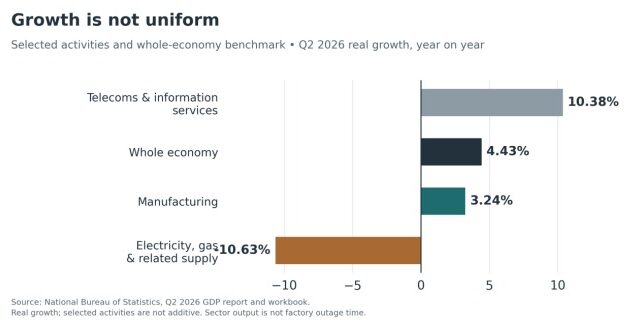 Selected activities overlap with the whole-economy benchmark; they are not additive. Power-sector output is not a measure of factory outage hours.
Consider a hypothetical cold-store investment. Its owner must estimate how much produce will arrive, what customers will pay and how quickly invoices will be settled. If refrigeration is interrupted, stock can be lost. If backup power is expensive, the margin narrows. If the lender requires repayment before the business has built a dependable customer base, a sound operating idea can become a poor financing proposition.
The owner can respond by buying more equipment, holding more cash and borrowing less. Those precautions may be rational for the individual business. They also mean that capital intended for expansion is diverted into protection against services that cannot be relied upon. The factory acquires a second job: insuring itself against its operating environment.
This is where the practical value of stabilisation should be judged. Reform earns its economic dividend when a business can reduce those protective costs without taking reckless risks. A credible exchange-rate framework is valuable partly because an importer can price a machine. Reliable power is valuable partly because that machine can operate for enough hours to repay its cost. These are connected stages of investment, not rival policy agendas.
It would be a mistake to conclude that monetary discipline should therefore be abandoned in pursuit of cheaper credit. A nominally inexpensive loan is no bargain if inflation or a currency shock destroys its assumptions. Nor should services-led growth be dismissed because it is less visible than a new factory. Communications, payments and transport can make production more efficient. The question is whether the different parts of the economy reinforce one another.
My priority would be to make reliable industrial power a demonstrable commercial proposition, rather than another promise attached to a project launch. Regulators, distribution companies, generators and industrial customers should be able to put forward agreements in which the obligations are clear: the supply to be delivered, the network charges to be paid, the customer’s payment commitment and the remedy when either side fails.
The commercial detail matters. A low tariff supported by an unreliable subsidy is not necessarily better than a higher, predictable price. A dedicated supply arrangement should not escape legitimate network costs or leave other customers carrying hidden liabilities. Investors need to know who maintains the equipment, who collects the money and what happens when a major customer stops paying. None of that is solved by describing a project as transformational.
Whether the equipment supplier is Nigerian, British, Chinese, German, or from anywhere else, the useful comparison is the same: what does an hour of dependable production cost, and can the customer afford it? The technology should follow that calculation and should include skill- and capacity building. It should not be selected to flatter the supplier, the financier or the government’s preferred photograph.
Publish the operating results, not merely the installed capacity. Show delivery, collections, downtime and the full cost to the participating businesses. A signed customer agreement is not the same as a collected electricity bill. Publishing those results would allow a working arrangement to be copied, and an unsuccessful one to be corrected before it becomes an expensive national template.
GDP growth remains an important measure of progress. But the recovery will become harder to dispute when a factory can expand without first building a second electricity business beside it. The generator house should be insurance against an exception, not the organising principle of Nigerian industry.
Disclosure: iKapital and the author’s affiliated organisations, RELEVATE and DREPS, work on energy, education and investment projects in Africa and may have interests in sectors discussed.