
 Get Guardian on Google
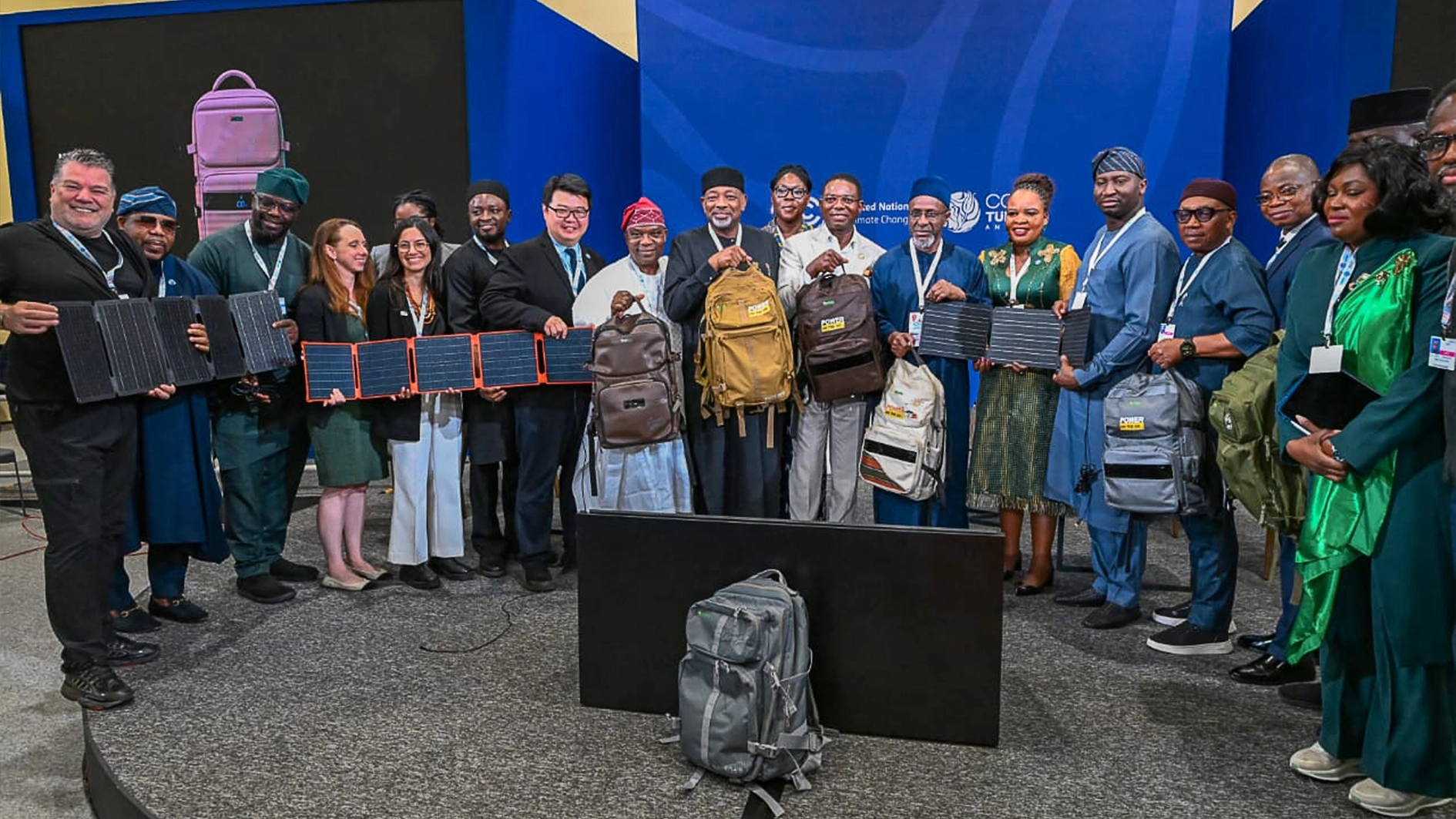
A Nigerian renewable energy company, Innovative Renewable Energy Storage Solution (iRESS) Ltd, has unveiled a Solar Inverter Backpack at the 31st United Nations Climate Change Conference (COP31) in Antalya, Türkiye, as part of efforts to expand electricity access to underserved communities across Africa.
The innovation, launched at an event tagged Power in Motion, is designed to provide portable electricity for households, small businesses, schools, healthcare centres and rural communities without reliable access to the national grid.
Alongside the product unveiling, iRESS Ltd and its parent company, RKK Group, launched the Antalya Call to Action on Mobile and Distributed Clean Energy, urging governments, development finance institutions, investors and international organisations to adopt practical measures to close Africa’s energy access gap.
Founder of iRESS Ltd and Group Chief Executive of RKK Group, Dr Aderemi Rasheed Kilaso, convened the session at Special Event Room 4, Perge Theatre, Antalya EXPO Centre, bringing together policymakers, development partners and energy stakeholders to examine how financing and regulation could accelerate access to portable solar power, mini-grids and battery storage.
In his keynote address, Nigeria’s Minister of Agriculture and Food Security, Senator Abubakar Kyari, stressed the connection between reliable electricity and food production, declaring that “there is no food security without energy security.”
He said dependable electricity was essential for irrigating farms, processing agricultural produce and preserving food, urging stakeholders to endorse the Antalya Call to Action and support innovative solutions capable of transforming rural livelihoods.
The event was attended by the Minister of Environment, Balarabe Abbas Lawal; Minister of State for Foreign Affairs, Ambassador Sola Enikanolaiye; and Chief Executive Officer of Sustainable Energy for All, Damilola Ogunbiyi, who delivered goodwill remarks. Enikanolaiye expressed pride in the Nigerian innovation.
The Solar Inverter Backpack stores solar energy and supplies electricity to power work tools and everyday appliances, including light bulbs, standing fans, televisions, point-of-sale terminals, mobile phones and laptops.
Its potential applications cut across classrooms, small shops, healthcare facilities and livestock farms, allowing users to undertake economic and essential activities beyond daylight hours without depending entirely on conventional electricity infrastructure.
The initiative comes amid a huge electricity access deficit across the continent. In 2024, about 655 million people worldwide lacked access to electricity, with 563 million living in sub-Saharan Africa, including approximately 87 million Nigerians.
The Antalya Call to Action argues that extending national electricity grids alone will not be sufficient to achieve universal access by 2030, stressing the need for mobile and distributed renewable energy solutions to reach rural and peri-urban households, displaced populations, persons with disabilities, frontline health workers, women and young people.
It also aligns with Mission 300, an initiative of the World Bank Group and African Development Bank Group targeting electricity connections for 300 million people across Africa by 2030.
The two institutions reported in June 2026 that the programme had connected more than 50 million people across 40 countries.
Similarly, the call welcomes Nigeria’s National Energy Compact, launched in Dar es Salaam in January 2025, which targets universal electricity access by 2030 and identifies distributed renewable energy as a least-cost pathway for connecting more than 60 million Nigerians.
Under the Antalya Call to Action, iRESS and RKK Group proposed six commitments, including recognising mobile and distributed clean energy in national electrification strategies, improving access to financing, and integrating portable electricity into education, healthcare, rural livelihoods and emergency response programmes.
Other commitments include promoting local manufacturing and assembly, developing technical skills and distribution networks, strengthening battery collection and recycling, and adopting transparent measurements to track electricity access, livelihoods supported, costs saved and emissions avoided.
The initiative also calls for governments, development finance institutions, investors, UN agencies, humanitarian organisations, businesses, civil society groups and young innovators to endorse the commitments and work towards their implementation.
Signatories are expected to reconvene at COP32 in Addis Ababa, Ethiopia, in 2027, to assess progress, share results and identify opportunities to scale up successful interventions.
Later at the Nigeria Pavilion, iRESS hosted The Unplugged Experience, a practical demonstration of the Solar Inverter Backpack that allowed participants to interact with the technology, ask questions and explore its applications.