 Follow Us on Google News


 Follow Us on Google Discover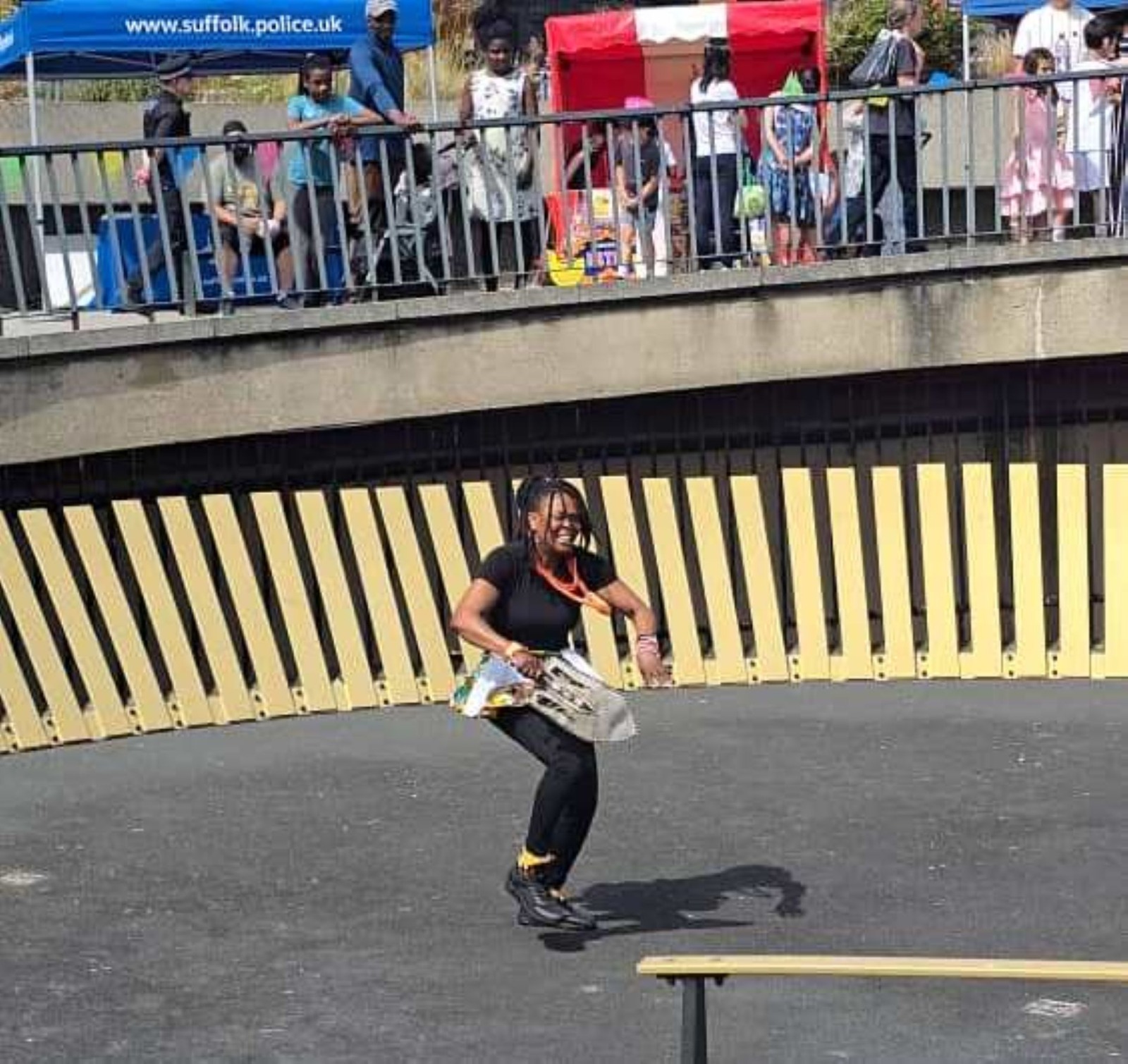
TRADITIONAL dance carries history in the body. Long before it is explained, the rhythm, footwork, and manner of gestures can tell a story about a people and where they come from.
That was the spirit Sophia Newton brought to The Big Afternoon at New Wolsey Theatre, Ipswich, on May 30, 2026, where she performed Traditional Urhobo dance as part of the free family event.
Sophia Newton is a dance and movement artist, author, creative educator, and founder of Express & Bloom. She is a member of the Royal Academy of Dance, a practitioner member of the English Folk Dance and Song Society, and also a fellow of the Arts in Medicine Fellowship.
She is the winner of Pizza & Pitches 2026 at The Albany and is currently developing Dance for Healing in Crawley, West Sussex, England, supported by Creative Crawley’s BOOST programme. Her work brings together movement, spoken word, and visual creativity to support wellbeing.
Newton took her performance outdoors in front of the theatre. Families and children gathered around the space as she danced, bringing the distinctive energy of Nigerian traditional dance into a setting filled with music, games and other creative activities.
It was a 10-minute performance, where dance became more than movement: it became a celebration of identity, culture, and shared joy.
Dressed in a black T-shirt, the Delta State University graduate, with experience in fine art, creative arts, teaching and performance, alongside a Master’s degree in Human Rights and Diplomacy from the University of Stirling, Scotland in partnership with the United Nations Institute and Research, created movements that appealed.
Her work stood out not only as a dance performance but as a vibrant cultural offering. Through movement, music, collaboration, and audience engagement, she presented a performance that celebrated African dance and the beauty of artistic connection.
The colours and accessories immediately gave the performance a strong cultural identity. The fan became part of her gestures, opening and closing with the movement and adding a playful quality to her presentation.
Newton danced with a firm grounding through the feet and a lively use of the upper body. Her arms were expressive, while her steps carried the rhythm forward. She did not remain in one place. She travelled through the space, changed levels and brought her body close to the ground before rising again.
At one point, she moved into a kneeling position, continuing the dance from there before returning to standing. It was a small but effective change that gave the performance another physical dimension.
Her enjoyment was also easy to see. She smiled as she danced and appeared comfortable with the people gathered around her. That ease mattered because the performance was not taking place on a conventional stage.
Children were watching from different positions, families were moving around the event and the theatre itself provided the backdrop.
But the most enjoyable part came when the audience began to dance too.
People joined in with the movement, smiling and responding to the rhythm. Some of the children confidently came forward and danced with real excitement. For a moment, the distinction between performer and audience became less important. Newton’s dance had become something people were sharing rather than simply watching.

That response says something about the strength of traditional dance as a form of communication. The children did not need to know the history of the Urhobo people before they could respond to the rhythm and movement, they simply joined in.
For Newton, however, the performance was also an opportunity to place Urhobo heritage within a contemporary British cultural space. The dance was not presented as a distant cultural display, it was performed with familiarity and confidence by someone carrying that tradition into another setting.
The participatory element made this even more meaningful. Children and adults were able to encounter Traditional Urhobo dance through their own bodies, rather than only seeing it performed for them. The happiness around the space gave the performance a communal quality that suited the family atmosphere of The Big Afternoon.
Newton’s work with Express & Bloom has increasingly created opportunities for Nigerian cultural traditions to meet audiences in the UK. Her practice brings together dance, cultural heritage, participation and performance, while giving particular attention to the relationship between people and the traditions they carry.
At New Wolsey Theatre, that relationship was clearly visible. Newton was not simply performing a dance from another part of the world. She was carrying Urhobo movement and cultural expression into a new environment and allowing people to experience it with her.
The children dancing alongside her may have been the simplest measure of its success. They were not standing back to admire something unfamiliar. They were enjoying themselves, joining the rhythm and becoming part of the dance.
And perhaps that is where traditional dance is at its most powerful: when heritage is not only preserved, but lived, shared and enjoyed.

