 Follow Us on Google News


 Follow Us on Google Discover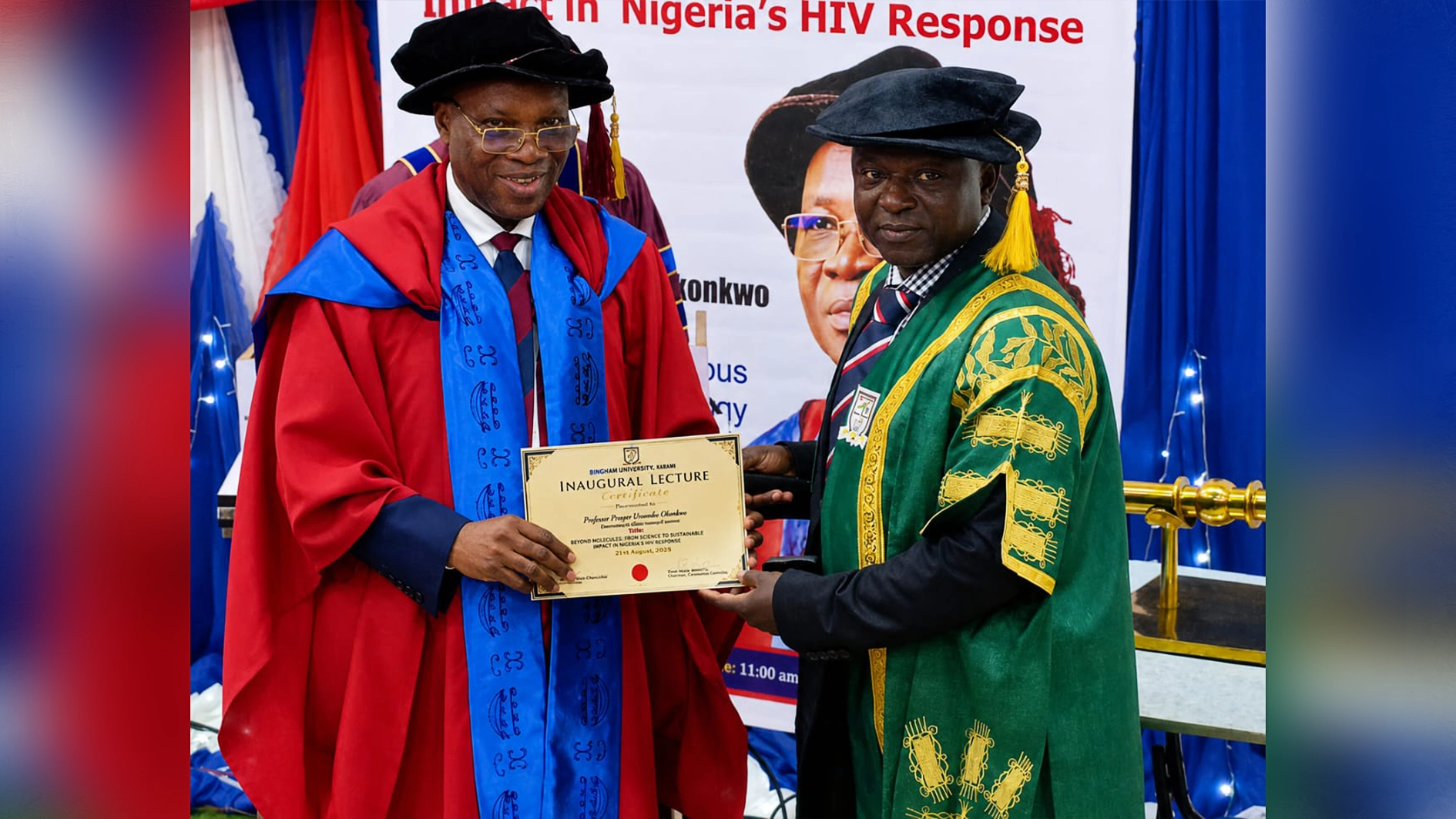
A Professor of Infectious Disease Epidemiology at Bingham University, Prosper Okonkwo, has disclosed that about 160,000 Nigerian children aged zero to 14 are living with HIV, while an estimated 22,000 new infections and 15,000 AIDS-related deaths among children were recorded in a single year.
Okonkwo warned that Nigeria must urgently move its HIV response beyond dependence on donor funding and build a sustainable, nationally owned system capable of protecting the gains recorded over the past two decades.
The scholar made the call in Abuja on Thursday while delivering the 14th inaugural lecture of the University, titled ‘Beyond Molecules: From Science to Sustainable Impact in Nigeria’s HIV Response.’
He said Nigeria had built critical biomedical infrastructure through its HIV response, warning that the country could not afford to allow such facilities and systems to deteriorate whenever international funding priorities changed.
According to the scholar, the laboratories established and strengthened through the HIV programme became the backbone of Nigeria’s COVID-19 response, demonstrating that investments in public health infrastructure could serve national interests far beyond the disease for which they were initially created.
“The laboratories we built for HIV became the backbone of Nigeria’s COVID-19 response when nothing else was ready,” Okonkwo said.

He urged the Federal Government to formally designate the infrastructure as a national health security asset, with sustainable funding and governance arrangements to ensure that the facilities remain functional in times of crisis.
While acknowledging that innovations in molecular science, vaccine research, and antiretroviral therapies have saved millions of lives, Professor Okonkwo emphasized that Nigeria must urgently address the complex socio-economic and cultural barriers hindering treatment adherence and prevention efforts across the country’s diverse populations.
The inaugural lecturer also called for the full integration of HIV services into Nigeria’s health insurance system, arguing that treatment should no longer depend largely on discretionary budgetary allocations or donor priorities.
He noted that Vietnam had increased the domestically financed share of its HIV response by incorporating treatment into national health insurance, while Thailand and Rwanda had adopted similar approaches.
Nigeria, he said, already had the institutional framework through the National Health Insurance Authority and state health insurance schemes, with 21.7 million Nigerians enrolled and a national target of 50 million enrollees by 2027.
“I recommend that HIV services be written into that benefit package as policy, with subsidised premiums and a published, multi-year timetable, not left as a discretionary line item that can quietly disappear when budgets tighten,” he said.
The don further urged the government to deepen the integration of HIV services into primary healthcare, saying Nigeria had already established the policy direction and begun transitioning large-scale programmes from international to Nigerian implementing partners.
He said HIV care had also been integrated in pilot programmes with hypertension management, mental health and reproductive health services, describing the approach as a practical way of strengthening healthcare delivery while reducing fragmentation.
Okonkwo said the government should focus on completing and adequately resourcing policies and programmes already initiated rather than continually introducing new ones.
He also highlighted progress in paediatric HIV treatment, noting that the proportion of Nigerian children requiring antiretroviral therapy who were receiving treatment had risen from 29 per cent before the deliberate national push to 74 per cent by 2024.
He called for sustained investment in paediatric antiretroviral therapy, prevention of mother-to-child transmission and early infant diagnosis, insisting that the progress achieved should be treated as a platform for further action rather than an endpoint.
The professor also stressed the importance of designing HIV services around trust, rather than simply proximity to health facilities.
He said community-based care had generally improved retention in treatment but warned that access alone did not guarantee that patients would remain in care.
According to him, differentiated service delivery must take into account the realities of adolescents, older people, women, key populations and poor Nigerians, while tackling stigma and legal and social barriers that can discourage people from seeking treatment.
Okonkwo said the five recommendations contained in his lecture were not radical proposals, but measures that had already been tested and shown to work in Nigeria and other countries.
“What is missing is not knowledge. It is the will to act on what we already know,” he said, challenging policymakers and stakeholders to translate decades of scientific and programme experience into a sustainable national HIV response.
Earlier, Vice-Chancellor, Bingham University, Professor Haruna Ayuba, declared that Nigeria’s battle against HIV/AIDS cannot be won by scientific breakthroughs alone.
The V-C underscored the need for a multidimensional approach that integrates scientific research with policy reform, education, community engagement, and robust health system strengthening to translate laboratory findings into accessible diagnostics and affordable treatment options tailored to local realities.
Professor Ayuba revealed that the College of Medical Sciences now leads the university’s academic rankings with five inaugural professors, followed by the Faculty of Social Sciences with three. The Faculty of Administration and Faculty of Science & Technology have two each, while Environmental Science and Law have one apiece—a clear call for other faculties to step up their academic contributions.
In their separate goodwill messages, the Vice-Chancellor, University of Lagos, Professor Folasade Ogunsola, and the Director-General, National Agency for the Control of AIDS (NACA), Dr Temitope Ilori, hailed the inaugural lecturer, describing the lecture as timely, insightful and a valuable contribution to public discourse on HIV/AIDS and infectious disease control.

