

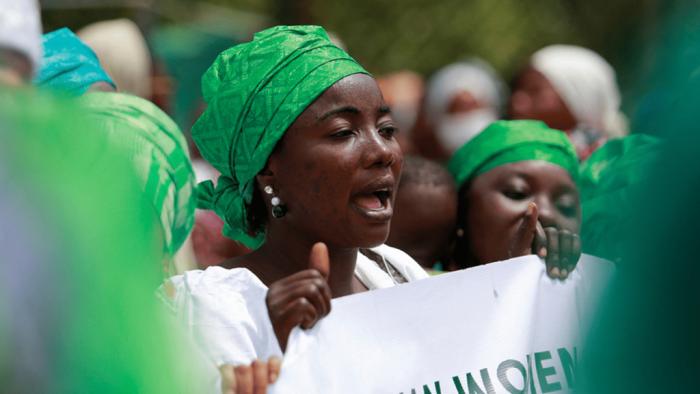
…As Reserved Seats for Women’s Bill kicks in
Thirty years after Nigeria committed to adopting and being a signatory to the Beijing Declaration and Platform for Action (BPfA), there is still a huge gap in the implementation of the 12 critical areas of women’s concern which provided a unique opportunity for women to become a critical part of decision-making process in matters relating to economic, political, and social advancement.
With the Convention on the Elimination of All Forms of Discrimination against Women (CEDAW), adopted by the UN General Assembly, that codified women’s rights to equality in all spheres of life as a global norm, Nigeria has still not played its part in activating these high-level policies. Key statistics show that since 1999, women’s representation in the federal legislature has never exceeded eight percent, with Federal and State representatives having the most women’s representation at the 6th Assembly, (with nine senators and 27 representatives totally 36 women). Today, this has drastically declined with four senators and 15 representatives out of 469 seats). For State Houses of Assembly, the narrative is same with 48 women elected out of 993 seats which accounts for 4.8 percent while local council elections boast of 3.7 percent of women.
In 2022, Nigerian women sort the passage of the five gender bills, which were rejected at the 9th National Assembly. The bills aimed to improve women’s participation in government and society, including special seats for women, citizenship for foreign husbands of Nigerian women, affirmative action in political party administration, criteria for indigenship for married women, and a 35 percent quota for women in political appointments.
Despite this brick wall, there is a gleam of hope as the Reserved Seat for Women bill which was passed for second reading on July 9, 2024, seeks the creation of additional seats exclusively reserved for women in the federal parliament and at the state assemblies. The bill sponsored by Deputy Speaker, Benjamin Kalu and 12 others seek to alter Sections 48, 49, 71, and 117 of the 1999 Constitution (as amended) to create one ‘Special seat’ reserved exclusively for women in the Senate and House of Representatives for each state of the federation and the Federal Capital Territory.
It proposes to create one senatorial seat and one House seat in each state and the FCT. The bill also proposes to alter Section 91 of the constitution to provide for three special seats ‘Reserved exclusively’ for women in the state houses of assembly. The bill which is a reform subject to review every 16 years, is focused on building a level playing field, not to create a permanent quota for women.
However, this new turn will be a deciding factor as legislators will this month move to vote for the future of women in politics. Founder of the Women in Leadership Advancement Network (WILAN), Abosede George-Ogan said that the reserved seats for women bill, which will be Nigeria’s first affirmative action law, is everybody’s business, because there is overwhelming evidence to show that when women lead, the economy is better, corruption is less, health and education outcomes increase, it’s our business.
“In Africa, Nigeria ranks 54 out of 54 in women’s political representation, even with our almost perfect Gender Policy document; a very beautiful document which gets updated every other time. There’s a lot of money we’re leaving on the table, according to the McKinsey report, when women are not at the highest level of governance, and so this is an opportunity for the 10th Assembly to make history.”
Gender inclusion advocate and Executive Director, Centre for Nonviolence and Gender Advocacy in Nigeria (CENGAIN), Asmau Benzies-Leo said the Reserved Seat for Women’s Bill is one of the most transformative steps Nigeria has taken towards its constitutional amendments in our national history. “After the painful rejection of the five gender bills including the Gender and Equal Opportunities Bill in 2022, many women felt discouraged and politically invisible, but with the reintroduction of this bill, it has indeed given us renewed hope. It provides structural guarantees that finally open the doors for women to participate meaningfully in governance not as tokens, but as equal stakeholders.
“From my experience working across communities and advocating for inclusive governance, I can say that the challenges women face in politics which includes financial exclusion, political violence, party gatekeeping, are not issues women can overcome individually. We need institutional reforms, and that’s exactly what the Reserved Seat Bill provides. It will create an enabling environment where qualified women can enter leadership spaces, be heard, and influence decisions that affect all Nigerians.
“Countries like Rwanda, Senegal, and South Africa have proven that when you deliberately increase women’s representation, you improve governance outcomes. Nigeria cannot continue to rank among the lowest in the world for women’s political participation. This bill will not just be about numbers; it’s about transforming our democracy so it works for everyone, including the millions of women and girls whose voices have been historically sidelined.”
For Nigerian women, Benzies-Leo noted that this bill represents a turning point, a doorway to long overdue inclusion. It will lead to greater representation and visibility. Women will finally be present in significant numbers in legislative chambers, shaping laws and policies based on lived realities for issues such as maternal health, education, Gender-Based Violence, economic empowerment, security, and social welfare.
“The bill will open a new pipeline of female political leadership. It will ensure stronger policy outcomes for families and communities, guarantee a more stable and inclusive democracy and enhance greater opportunities across all sectors. The Reserved Seat Bill (HB1349) has the potential to reshape Nigeria’s political landscape ahead of 2027 in a very powerful way. If passed and implemented the way it should be, we will see a significant rise in the number of women entering state and national legislatures. That will change everything in the parliament, from policy discussions, budget priorities, development planning, and how political parties operate.
“For many years, women have been the backbone of voter mobilisation, community engagement, and even party survival. Yet when it comes to sharing power, the same system excludes them. This bill forces a shift, it compels political parties to rethink their internal culture and begin truly supporting women, not just using them for campaign activities.
“What excites me the most is the pipeline it will create. Reserved seats allow more women; young women, rural women, and marginalised women to gain the experience, visibility, and confidence needed to eventually contest open seats. It breaks the cycle of exclusion that has held women back for decades,” she added.
For human rights activist and founder, Kudirat Initiative for Democacry, Hafsat Abiola-Costello, she noted that global studies have shown that it is the best way to boost women’s representation in politics. “I understand the hesitation of those who may oppose the bill – their valid concern that after the 16 years of allocated seats women would again be relegated to the sidelines. However, I do not hold this view, largely because of the evidence from Rwanda where most of the women who came into the legislature came through allocated seats and, having proven their value, successfully competed for non-designated seats. I hope the bill passes. Nigeria’s women have so much to contribute to our country and deserve proportional seats at the decision-making table in order to do so.”
While South-South coordinator, Reserved Seats for Women’s Bill, stressed that there will be a shift in the Nigerian political scene when the bill is passed. “This will restore credibility after the five failed gender bills. A lot of women that have been discouraged from going into politics nationwide would begin to embrace politics again. The distrust that was created in the political scene would be doused and more women would want to be involved now.
“Then the deepened apathy amongst women who have boldly come out to run for office, would also be cheered up because they will now see that the government is serious about including more women in the government. It will restore trust in the government’s commitment to having more women and signal a real political turning point for women. It will reignite passion for the woman who is interested in going into leadership. So, those women who have appetite for politics will come out and begin to veer for positions that are rightfully theirs. Again, it will reposition Nigeria in the global scene as ready for reform. This immediate impact will be seen because our elections are coming up.
“And as the elections come up, structural changes will be made to accommodate women. We cannot but thank the 10th Assembly enough for this great investment in women. The reserve seat bill not only removes women’s participation from negotiation, it locks it into the constitution and makes inclusion non-optional, but enforceable,” she added.
