

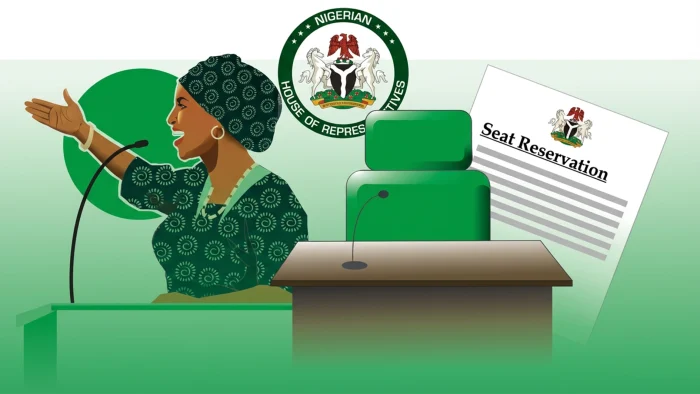
Ahead of the parliamentary vote on the Special Seats Bill, top women leaders, legislators, and political stakeholders have reiterated that Nigeria’s democracy risks continued stagnation unless women’s representation is urgently expanded through constitutionally guaranteed seats.
The Stakeholders’ during a Roundtable on the Countdown to the Vote on the Special Seats Bill held in Abuja pushed a unified call yet to the National Assembly to “Pass the bill now.”
Delivering the keynote, Minister of Women Affairs, Hon. Imaan Sulaiman-Ibrahim, said the Bill marks a defining test of Nigeria’s commitment to equality, especially as the country observes the global 16 Days of Activism on Gender-Based Violence.
She described Nigeria’s current gender imbalance as “structural and systemic,” noting that only 21 women serve in the National Assembly out of 469 lawmakers, and 13 states have no female legislator at all.
“This is not about competence; it is about decades of barriers. Give Nigerian women something to cheer about. Let this Bill be our collective commitment to democracy that works for everyone,” said.
She urged lawmakers to align with global and African reform trends, stressing that countries like Rwanda, Senegal, and Uganda have adopted similar frameworks with measurable success. “As Africa’s largest democracy, we must lead by example. Let this Bill be the Christmas gift Nigerian women deserve,” she said.
The APC National Women Leader delivered one of the day’s most powerful interventions, citing stark continental contrasts. While Rwanda’s parliament is nearly 64 percent female and several African nations exceed 40 percent, Nigeria remains at the bottom with only 3.9 percent women in the House of Representatives and 2.8 percent in the Senate. She described the Bill as “not radical, but corrective,” adding: “For 65 years, women have waited. We do not want to wait another year. The time to pass this bill is now.”
She called on lawmakers, governors, traditional rulers, civil society, and the media to “rally without hesitation,” insisting that political leaders have a historic opportunity to “write their names in gold.” According to her, “This is not just about numbers; it is about justice, equity, and building a democracy that reflects the Nigeria we claim to be.”
Representing political party women leaders across the country, the National Women Leaders’ Forum declared the vote a test of national conscience and democratic maturity. The Forum stressed that women have driven community development, peace-building, and economic resilience for decades, yet continue to be sidelined in key national decisions.
“The Special Seats Bill is not a favour, it is a democratic necessity,” the Forum’s representative said. “Let this moment be the one in which Nigeria chooses inclusion and strengthens its democracy.”
She added that women leaders across all political parties are united in a single message to legislators: vote yes. “Let us make history together. Nigeria cannot rise while shutting out half of its population from the decision-making table.”
Former senator and National Women’s League leader, Senator Grace Bent, warned lawmakers against adopting diluted alternatives that offer only minimal representation. She said proposals suggesting one seat per geopolitical zone “amount to nothing” and would return the nation to “square one.” “If 45 percent of Nigerian women’s voices are absent in decision-making, how do we strengthen democracy?” she asked.
Bent appealed directly to the Senate President and House Speaker to embrace the fuller model advocated by women’s groups, arguing that Nigeria’s democracy cannot advance when half of its citizens are excluded. “The parliament is the engine room of democracy. Without women at the table, we have already weakened its foundation,” she said. “This is the moment to write your names in gold.”
In a brief but forceful intervention, Hon. Amina Kadi joined the call for urgent action, noting that women are not demanding equal numbers, but a fair minimum. “We are appealing, on our knees, for the passage of this bill,” she said.
“A woman at the decision table speaks not for herself, but for the family, the children, the nation. Passing this bill will redeem Nigeria’s image and finally correct a historic wrong.”
She urged President Bola Ahmed Tinubu to back the legislation fully, saying national credibility and democratic progress depend on it. “Nigeria calls itself the giant of Africa; this is the time to act like it,” she added.
As the countdown to the vote enters its final stretch, one refrain echoed throughout the hall, “Pass the Bill.” Women leaders insist that the 10th Assembly has a rare opportunity: to reshape history, restore balance, and finally deliver representation reflective of Nigeria’s population.
