

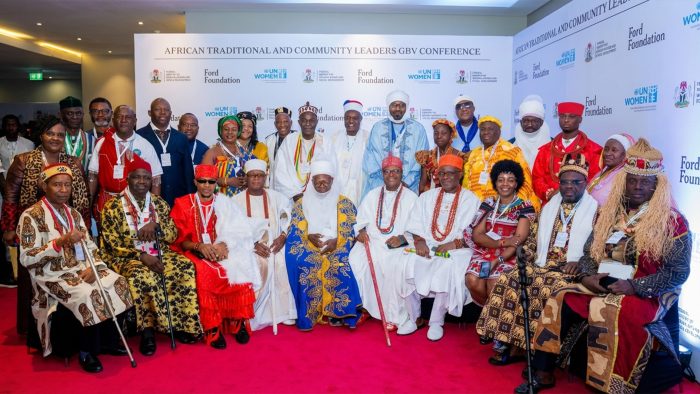
Across Africa, gender-based violence remains one of the most persistent threats to human dignity, family stability, and national development. It is also one of the most normalised crises hidden behind silence and stigma. Globally, the World Health Organisation has reported that about one in three women experience physical or sexual violence in their lifetime, and across many parts of sub-Saharan Africa the prevalence remains particularly high.
UN Women has repeatedly drawn attention to the fact that countries lose billions in productivity and public spending responding to violence through health systems, policing, justice processes, and the lifelong consequences carried by survivors. These realities framed the urgency of the African Traditional and Community Leaders Gender-based Violence (GBV) Conference 2026, held earlier in the week in Lagos, concerns on how culture which shapes behaviour can serve as a tool to end harm.
Organised by the Ford Foundation and UN Women, in collaboration with the Federal Ministry of Women Affairs and Social Development, the gathering brought together traditional rulers and community leaders from across the African continent to deliberate and chart a path for gender-based violence prevention through the theme, ‘Driving norms change and gender-based violence prevention through cultural custodianship.’
Flagging over the two-day conference, Lagos state Governor, Babajide Sanwo-Olu, represented by Commissioner for Health, Prof. Akin Abayomi, described the conference as timely and significant, while noting that GBV is one of the most destructive challenges confronting societies. “It robs us of dignity, security, opportunity, and in too many cases, life itself. It weakens families, fractures communities, and undermines sustainable development.
“Across Africa, our societies look to traditional and cultural leadership for moral guidance, social stability, and the preservation of values. When such leadership comes together to confront an issue as serious as gender-based violence, it tells that silence is no longer acceptable, and that change must be intentional.”
Prof. Abayomi described Lagos’ institutional efforts through the Lagos State Domestic and Sexual Violence Agency, survivor support systems, reporting mechanisms, and legal enforcement. While noting on the limits of the law, he said, “Laws alone cannot change culture. Sustainable change happens when governments work with traditional institutions, faith leaders, families, and communities to reshape attitudes, behaviours, and expectations.”

Ford Foundation President, Heather Gerken highlighted the importance of grounding progress in cultural legitimacy, noting that the challenges women and girls are facing across Africa and indeed the world are real, but so is the immense potential of the region to inspire new ways forward. While from a global policy perspective, Deputy Executive Director, UN Women Nyaradzai Gumbonzvanda, drew attention to the structural roots of abuse, warning, “we know what we are calling marriage is actually sexual abuse of girls. Gender-based violence is not the root problem; it is one of the clearest symptoms of the need to affirm the norms and institutions that ensure equality and justice for all.”
For Director of the Ford Foundation, West Africa Dr. Chichi Aniagolu, she said that across Africa, communities are being quietly broken by violence against women and girls. “Too often, harmful practices are defended in the name of tradition. But culture is not static. It is shaped by those entrusted to lead it, and ending harm does not weaken authority, it strengthens it.
“Violence in the home is not private. It weakens families, disrupts livelihoods, affects children’s education, and erodes community harmony. Where formal justice systems are distant, traditional courts matter deeply, their words carry weight, what they condemn, people abandon and what they permit, people repeat.”
On his part, UN Women’s Regional Director for West and Central Africa, Dr. Maxime Houinato said the UN Women’s research have shown that social norms are embedded in rules and structures that sometimes are hard to change. While acknowledging the difficulty of altering inherited belief systems, he noted that the discomfort of the conversation is not a reason to evade it. “What we have noticed particularly in Africa is the spread in both urban and rural areas, and also how much government is spending to address the issue of gender-based violence.
“At the moment, a lot of countries spend about seven percent of their GDP addressing the consequences of GBV, which is sometimes more than they spend on agriculture. That’s why the Ministry of Finance, Ministry of Planning became interested in GBV. The particularity of Lagos is that, Nigeria being a big country, when things move in Nigeria, the continent moves.”
Emir of Shonga and Convener-General of the Council of Traditional Leaders of Africa, Alhaji Dr. Haliru Yahaya Ndanusa, on his part, said, “As custodians of values, we shape norms, behaviour, and accountability in our communities, and we must be honest that some harmful practices were sustained by us. Through COTLA, we are confronting child marriage, female genital mutilation, and other abuses, aligning our work with SDG 5 and Agenda 2063. I have seen before during the polio crisis that when community leaders act, change happens. Culture is not above scrutiny. Religion does not justify harm. Our authority carries responsibility, and we must use it to protect dignity, justice, and the future of our people.”
Further buttressing traditional roles, Obi of Onitsha, Igwe Nnaemeka Alfred Ugochukwu Achebe, said that cultural authority is not ceremonial but operational. “Too often, victims remain quiet because of shame, fear, or the belief that speaking up is taboo. My responsibility is to break that silence and encourage people to come forward, knowing they will be heard and protected.
“Traditionally, marriage is between families. If a woman is harmed, she returns to her family, and the matter is addressed collectively. In the 21st century, there is no place for gender-based violence, whether hidden or overt. In my community, we expose it and act on it.”
Dein of Agbor, Benjamin Keagborekuzi Ikenchukwu Gbenoba I, said, “I see my role as a custodian of culture not as preserving everything I inherited, but as questioning what no longer serves our people. As a young monarch who grew up abroad, I see things differently. I often ask a simple question that unsettles many: how do you become violent towards women, knowing fully well that you are born of a woman? That contradiction troubles me deeply. We keep saying women mind our homes and raise our children, but they are not going to mind our societies if we continue to shut them out. Women are just as intelligent as men. They can do anything a man can do. The issue is not giving women more opportunities, but giving them the same chances. That is where real progress begins.”
A female traditional ruler from Ghana, Nana Hemaa Adwoa Awindo who is also the Executive Director and Founder of the Obaapa Development Foundation, said, “everything we do is centred on protection, especially when it comes to gender-based violence. Through the Obaapa Development Foundation, we have designed and implemented programmes across Ghana that protect girls, women, and communities as a whole. One of our strongest interventions is ending child marriage. We have partnered with UNFPA, received capacity building support from UN Women, and worked directly with paramount chiefs across the country. As I speak today, we have secured public declarations from 10 paramount chiefs committing to end child marriage. This is no longer just advocacy; we are committing, acting, and counting our gains.”
UN Women Representative to Nigeria and ECOWAS, Beatrice Eyong, said, “I believe strongly that transforming harmful traditions must begin where people live. Traditional rulers are closest to the communities; they sit at the base of society, not at a distance. That is why change cannot only happen at national or capital-city level. We have to go down to where violence is happening, where norms are formed, and where lives are affected daily. That is what makes this engagement so important, because we are already seeing change, progressive gender norms, traditional leaders creating safe spaces for women, speaking out against gender-based violence, and advocating for women’s inclusion in decision-making.
“This work is not limited to Nigeria. Gender-based violence is a continental issue, and the African Union convention on ending violence against women and girls gives us a shared framework. What we are doing here supports implementation across Africa. We also work with religious leaders, ensuring these messages reach churches and mosques, where norms are reinforced. Many of today’s traditional leaders are highly educated – scientists, medical doctors -who understand the harm these practices cause and are committed to shifting norms.”
While assistant Secretary-General, Resident and Humanitarian Coordinator in Nigeria, Mohamed M. Malick Fall, closed the leadership interventions by reminding traditional authorities of the weight of their influence, adding, “in the fight against gender-based violence, your influence saves lives. Communities listen to those they trust. When leaders champion dignity, equality and protection, futures are transformed.”
