

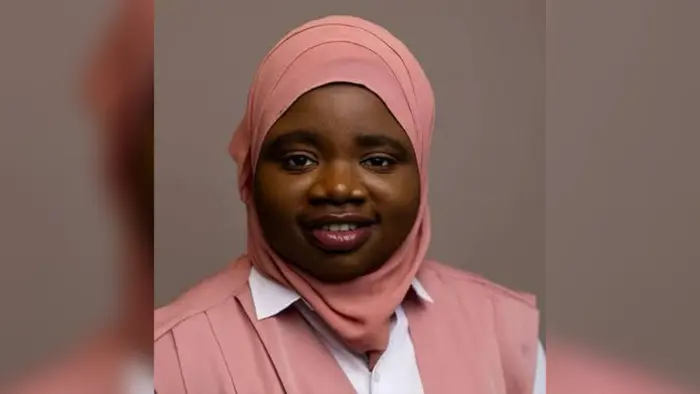
Zainab Aderinwale is a researcher, author, entrepreneur, and government-appointed public leader committed to advancing women’s economic freedom through policy, psychology, and systems. She serves as Commissioner for the Upper Middlesex Commission on the Status of Women in Massachusetts and as USA Country Chair for G100: Mission Million. She is also the CEO of Eartco Counselling and Consulting and a Board Member at FirstFounders Venture Studio, where she supports founders and women entrepreneurs in building sustainable organisations.
Zainab is the creator of the Passion Problem Solution Founder Framework, a psychology-driven model adopted by organisations and government programmes in Nigeria. She holds a Master’s degree in Diversity, Equity, Inclusion and Justice Leadership from Tufts University and a BSc in Psychology from Obafemi Awolowo University. She is also the author of two books and the creator of Aso Oke AI, an emotion-sensing smart jacket that combines Yoruba cultural heritage with artificial intelligence.
In this interview with Esther Ijewere, she shares her story.
My Inspiration
Growing up in Nigeria, I watched brilliant women around me work twice as hard for half the recognition. They had the talent, the drive, and the ideas, but the systems around them were not built for them to succeed. That gap between potential and opportunity stayed with me. When I began studying organisational psychology, I found the language to name what I had always observed: that the barriers women face are structural, not personal. That realisation turned inspiration into commitment. I stopped asking why women were not succeeding and started asking what structures needed to change so they could.
How Psychology Shapes My Leadership
Psychology taught me to ask different questions. Most leadership frameworks ask what skills someone has. I ask what conditions someone needs to thrive. That shift changes everything from how I evaluate founders using the PPS Framework to how I design mentorship programmes at the Massachusetts Caucus of Women Legislators. Organisational psychology gave me a way to build systems that account for the human beings inside them, their motivations, their fears, their strengths, and the structural barriers they are navigating. You cannot build effective systems for people without understanding people first.
Serving Women Through Public Policy
I serve as a Commissioner for the Upper Middlesex Commission on the Status of Women, a government body of the Commonwealth of Massachusetts covering 40 cities and towns including Cambridge, Lowell, Somerville, and Newton. My role involves advancing gender equity through policy, advocacy, and governance at the regional level. I attend official government convenings, contribute to the Commission’s policy priorities, and represent the interests of women and girls across my region. It is deeply meaningful work because it connects my research directly to the policy environment that shapes women’s lives in real and immediate ways.
Building Global Connections for Women
Honestly, my biggest hope is connection. There are so many women in the United States, especially women from the African diaspora, who are doing extraordinary work in complete isolation. They do not know that there is a global network of women leaders, including Nobel Laureates and former Heads of State, who are working on the same things they are working on. My job as USA Country Chair is to build that bridge. I want women across America to know they are not alone in this work and that there is a seat for them at the highest tables in the world.

Helping Organisations Scale Through the PPS Framework
The PPS Framework gives organisations a structured psychological tool for evaluating founder readiness, something the investment ecosystem has never had before. Most organisations evaluate ideas. The PPS Framework evaluates the person behind the idea, their passion alignment, their depth of problem understanding, and the coherence of their solution. When organisations use PPS, they stop making expensive mistakes by backing founders who are excited about a concept but not genuinely equipped to see it through. FirstFounders Venture Studio adopted PPS as their core selection methodology and documented a 6.5x average return on invested capital. The Osun State Government of Nigeria adopted it for their women’s entrepreneurship programmes reaching over 1,000 women. When you evaluate founders well, the organisations you build are stronger from the foundation.
Lessons From Supporting African Founders
That the biggest barrier African founders face is not capital; it is confidence that their context matters. Too many frameworks and investment tools were built in Silicon Valley for Silicon Valley problems. When African founders are evaluated using those tools, they are told they do not fit rather than that the tool does not fit them. Working with 47 founders across Nigeria and the United States taught me that passion is universal, but the problems worth solving are deeply contextual. The PPS Framework works because it meets founders where they are, not where a Western investment thesis expects them to be.
Why Policy and Systems Matter
Because you cannot inspire your way out of a broken system. I have seen incredibly talented women work themselves to exhaustion trying to succeed in environments that were never designed for them to succeed. And we keep telling those women to work harder or believe more. But if the policies are not there, if there are no protections, no equal access, no structures that account for the realities women face, then all the inspiration in the world will not move the needle. I am not against inspiration. I just think we owe women more than that. We owe them systems that actually work for them.
The Story Behind the Aso Oke AI Smart Jacket
My grandmother wore Aso Oke to every important moment of her life. When I came to America, I noticed the world did not know Aso Oke’s name or story. I also noticed that young African professionals like me were navigating the world with two invisible things: emotions and heritage, both real and powerful and completely unseen. I built Aso Oke AI to make both visible. A smart jacket built on real Aso Oke fabric that reads your emotions in real time through biometric sensing and changes colour accordingly while carrying the full Yoruba cultural story in a single NFC scan. I built it in 48 hours alone at the Hack Nation 5th Global AI Hackathon under MIT and the World Bank. It is not just a jacket. It is infrastructure for cultural dignity in the age of artificial intelligence.
Balancing Research, Entrepreneurship and Public Service
I will be honest, I do not balance it at all. Some days it is just survival. But what keeps me going is that none of these things feels separate to me. When I am at the State House working on the mentoring programme, I am thinking about my research on structural resilience. When I am coaching a founder using the PPS Framework, I am collecting real data about how women navigate systems. Everything feeds everything else. It is not always graceful, but it is always purposeful. And purpose is what gets me up in the morning.
Message to Women
Your location is not your limitation. Some of the most significant contributions to global systems thinking, gender policy, and economic innovation are coming from women in the diaspora, women who carry multiple contexts, multiple languages, and multiple ways of seeing the world. That multiplicity is not a disadvantage. It is your greatest asset. Build from where you are. Use your Canadian networks and your African roots and your international perspective together. The world needs solutions that can work across contexts, and you are uniquely positioned to build them.
Being a Woman of Rubies
I think what makes me a Woman of Rubies is that I have never let not being ready stop me from starting. I did not have all the answers when I developed the PPS Framework. I did not have all the resources when I began presenting my research internationally. I did not have all the connections when I started advocating for women in government. But I started anyway. And I kept going. A ruby is only precious because of the pressure it survived.
I am still under pressure. But I am still here.
Women Who Inspire Me
The first is Professor Asia Eaton at Florida International University. She is one of the most accomplished feminist social psychologists in the world, and when I met her at a conference, she treated my work with the same seriousness she treats her own. She did not gatekeep. She began talking about collaborating. That kind of generosity from someone at her level changed what I believed was possible for me.
The second is Shaitia Spruell, Executive Director of the Massachusetts Commission on the Status of Women. She runs a government agency with so much heart and so much fire at the same time. She reminded me that you do not have to choose between being powerful and being warm.
The third is my mother. She raised me in circumstances that would have broken a lot of people, and she never once let me believe that where we started was where we had to stay. Everything I am building is for her and because of her.
