 Follow Us on Google News


 Follow Us on Google Discover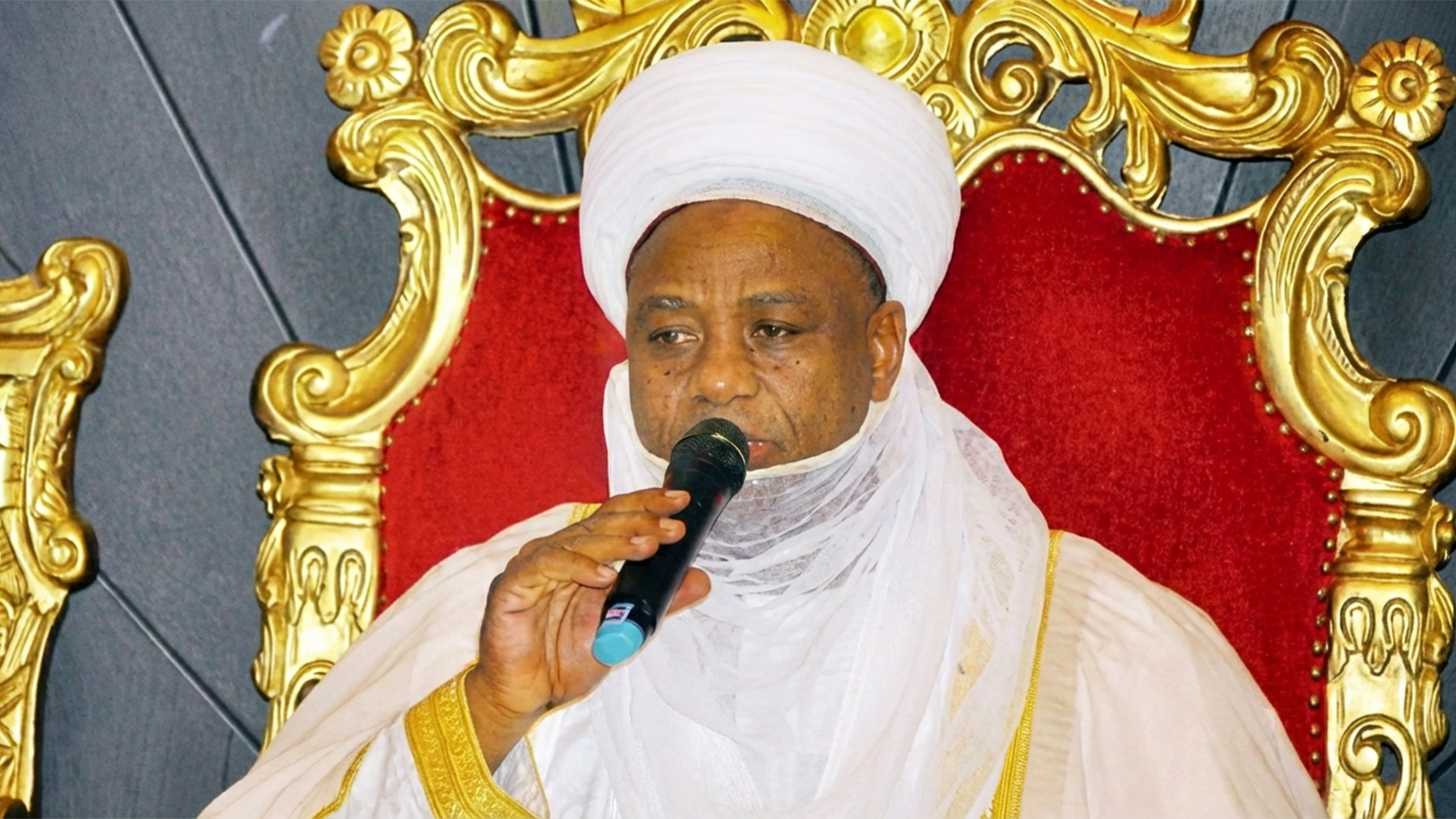
• Sultan urges voters to weigh campaign promises, shun divisive politics
• Akiolu backs Tinubu, declares ‘no vacancy’ in Aso Rock
• Yari touts Tinubu’s record, seeks monarchs’ support for re-election
• ADC, Atiku’s aide demand exclusion of partisan lecturers from election duties
• REC flags apathy, vote buying, misinformation ahead of 2027 polls
The Sultan of Sokoto, Muhammad Sa’ad Abubakar, and the Oba of Lagos, Rilwan Akiolu I, yesterday offered contrasting messages on the 2027 presidential election as the All Progressives Congress (APC) Presidential Campaign Council began consultations with traditional rulers.
While the Sultan urged Nigerians to carefully assess the promises of politicians before deciding who to vote for, Akiolu endorsed President Bola Tinubu’s bid for a second term, declaring that there was “no vacancy in Aso Rock” for the next four or five years.
The Sultan also cautioned political parties and their candidates against politicising insecurity and other national challenges during campaigns, urging them to focus on issues that would promote peace, unity and development.
He spoke yesterday when he received the APC 2027 Campaign Council, led by its Director-General, Abdul-Aziz Yari Abubakar, at his palace in Sokoto.
He urged voters to listen carefully to politicians’ promises during the electioneering period and make their choices based on what they believe would best serve their interests and those of the country.

The Sultan also called on political parties and candidates to conduct peaceful, issue-based campaigns, respect the choices of the electorate and play politics in a manner that would strengthen national unity and development.
He said no government anywhere in the world could completely eradicate insecurity and poverty, but that governments could work towards reducing their effects on the people.
The Sultan wished members of the APC campaign council success and prayed for continued peace, stability and good governance in Nigeria.
Earlier, Yari said the delegation visited the Sultan to seek his fatherly guidance, advice and prayers ahead of the 2027 general elections.
He said President Bola Ahmed Tinubu had, even before becoming president, demonstrated commitment to the development of the North and the country by supporting other leaders and development initiatives.
Yari said the APC-led Federal Government had several achievements to present to Nigerians, particularly under Tinubu’s administration.
According to him, the administration has remained committed to promoting peace, unity and cohesion across the country.
Yari assured the Sultan that the party would conduct peaceful campaigns and appealed for his continued support and prayers.
For his part, the Oba of Lagos, Rilwan Akiolu I, insisted that there was no vacancy in Aso Rock ahead of the 2027 general elections, expressing confidence that President Bola Tinubu will secure a second term based on his performance in office.
Akiolu spoke when Yari and members of the council, accompanied by Lagos State Deputy Governor, Obafemi Hamzat, paid a courtesy visit to his Iga-Iduganran Palace in Lagos Island.
Also speaking during the visit, Yari and Governor Babajide Sanwo-Olu described Tinubu as a formidable political leader, with Yari referring to him as the “generalissimo of Nigerian politics”.
Sanwo-Olu, who led the delegation to the palace after receiving the campaign council members at the airport, described the team as a group of experienced Nigerians comprising former Senate presidents, governors, speakers and senior party leaders.
He said Lagos was a natural starting point for the council’s nationwide consultations, while acknowledging the role of traditional rulers in promoting peace, unity and national development.
Yari said the delegation was at the palace to pay homage to the monarch and seek his royal blessing and support ahead of the elections.
He reflected on the emergence of the ruling APC and praised Tinubu’s political resilience, recalling his political battles as a former governor and his efforts in building the party’s political structure.
Yari urged party members and the media to focus on communicating the administration’s policies and achievements, particularly in economic growth, youth empowerment and national security.
He said Tinubu had demonstrated the capacity to tackle issues including currency stability, inflation and infrastructure development despite the country’s limited resources.
Yari said: “Asiwaju Bola Tinubu is a foundational leader who has laid the foundation, who has done the structural work necessary for this country to develop—not just for the next 10 years, but as far as 25 years and 30 years.”
Responding, Akiolu urged Nigerians, irrespective of religious affiliation, to promote honesty, hard work, critical thinking and sincerity of purpose.
The monarch also endorsed Tinubu’s bid for a second term, stressing the need for unity and peaceful political competition.
“Politicians don’t fight; they only disagree to agree later,” Akiolu said, urging stakeholders to promote a peaceful and accessible electoral process.
Recalling his relationship with Tinubu, the monarch said his nomination as Oba of Lagos was approved by the Lagos State Government in May 2003, during Tinubu’s tenure as governor.
He also commended successive administrations in Lagos for the state’s development, while praising Sanwo-Olu and Hamzat for sustaining infrastructure development.
Akiolu declared: “One important thing that I know very well is that for the next four or five years, there is no vacancy in Aso Rock.”
He urged politicians to avoid treating political disagreements as permanent divisions, citing the history of alliances in Nigerian politics.
The monarch, however, called for special status for Lagos, arguing that the state bears a disproportionate infrastructural and public-service burden as Nigeria’s commercial hub.
He said Lagos accommodates millions of Nigerians and visitors daily and therefore deserves greater federal support to sustain its development.
Akiolu, a former Commissioner of Police, also stressed the importance of integrity, prudent management of public resources and long-term planning by public officials.
He urged the incoming administration to preserve the legacy of Nigeria’s founding fathers while ensuring that Lagos receives adequate federal support.
ADC demands removal of partisan lecturers as 2027 election officials
MEANWHILE, the African Democratic Congress (ADC) has called on the Independent National Electoral Commission (INEC) to remove partisan lecturers from consideration as Returning and Collation Officers for the 2027 general elections.
The opposition party said the measure was necessary to protect the integrity and credibility of the elections, urging INEC to immediately review its criteria for appointing academics and other prospective election officials.
The ADC made the call following a newspaper report that more than 600 senior lecturers from public universities across northern Nigeria had endorsed President Bola Ahmed Tinubu for the 2027 presidential election.
The party said the development raised concerns about electoral credibility and potential conflicts of interest, given the role routinely assigned to university lecturers and vice chancellors in collating election results and declaring winners.
While acknowledging the constitutional right of every Nigerian, including academics, to support or endorse any political candidate, the ADC said anyone who had openly taken a partisan position should not subsequently be entrusted with determining the outcome of an election involving that candidate.
The party’s National Publicity Secretary, Bolaji Abdullahi, said: “You cannot campaign for a candidate and then be entrusted with counting the votes and declaring winners in the same election that your candidate is contesting in.”
The ADC urged INEC to establish and publish clear criteria for disqualifying academics and other prospective election officials who had publicly endorsed candidates, participated in partisan political activities or demonstrated an obvious political affiliation.
It also called on the commission to publish the names of proposed Returning and Collation Officers sufficiently ahead of the elections to enable political parties and members of the public to identify and raise legitimate conflict-of-interest concerns.
“The integrity of an election does not begin when the first ballot is cast. It begins with the neutrality of the people entrusted to administer, collate, and declare its outcome. Nigerians must never be placed in a position where those who have publicly chosen a side are subsequently presented as neutral arbiters of the contest,” the party said.
Atiku’s aide urges INEC to bar partisan academics from sensitive 2027 roles
SIMILARLY, the Senior Special Assistant on Public Communication to the ADC presidential candidate, Atiku Abubakar, Phrank Shaibu, urged the Independent National Electoral Commission to bar academics who openly endorse political candidates from sensitive electoral duties in the 2027 elections.
Shaibu made the call while reacting to reports that more than 600 senior academics from public universities in northern Nigeria had endorsed President Bola Tinubu’s bid for a second term.
The reported endorsement was made at a meeting in Kaduna convened by the presidential adviser, Ibrahim Masari.
The academics reportedly acknowledged that Tinubu inherited economic challenges and that some of his reforms had increased hardship, but cited progress in education, agriculture and infrastructure as reasons for supporting his administration.
However, the President of the Academic Staff Union of Universities (ASUU), Chris Piwuna, disowned the endorsement, saying the union remained apolitical and had never endorsed political candidates.
In a statement issued yesterday, Shaibu accused the Tinubu administration of eroding the dignity of academics by drawing them into partisan politics.
He said lecturers had a constitutional right to support, campaign for and vote for candidates of their choice, but argued that academics who publicly endorsed a presidential candidate should not subsequently serve in sensitive electoral positions.
According to him, such positions include Returning Officers, Collation Officers and other officials involved in the collation, declaration and announcement of election results.
“Electoral credibility requires not only actual neutrality, but also public confidence in the neutrality of those administering the process,” he said.
Shaibu also criticised the reported presence of elected governors and a serving Minister of Defence at the endorsement, describing it as evidence of the ruling party’s efforts to secure Tinubu’s re-election.
He said universities should remain centres of independent thought, scholarship and intellectual freedom rather than become recruitment grounds for political organisations.
Shaibu urged INEC to take note of academics who had publicly declared partisan allegiance and exclude them from sensitive electoral responsibilities in the 2027 elections.
REC raises concern over voter apathy, vote buying ahead of 2027 polls
RELATEDLY, the Resident Electoral Commissioner (REC) in Oyo State, Prof Adeniran Tella, has raised concerns over voter apathy, vote buying and the spread of misinformation and disinformation ahead of the 2027 general elections.
Tella consequently called for stronger grassroots voter education and public enlightenment to ensure that eligible citizens understand their rights and responsibilities, as well as the electoral process.
He made the call in Ibadan yesterday at a one-day capacity-building workshop for State Voter Education Desk Officers and Assistant Electoral Officers from Oyo, Ogun and Lagos states.
Tella said the credibility of the 2027 elections would depend not only on activities on election day but also on the level of voter education and public enlightenment conducted in the months preceding the polls.
He identified voter apathy, vote buying, misinformation and disinformation, alongside the difficulty of reaching citizens in urban and remote communities, as major challenges requiring innovative voter education strategies.
According to him, voter education officers must take accurate electoral information to the grassroots and engage communities through channels that are accessible and trusted by the people.
He urged the officers to strengthen engagements with traditional institutions, youth and women groups, community organisations and other stakeholders, while leveraging community radio, local newspapers, markets, religious institutions and social media platforms.
Tella said voter education should cover critical aspects of the electoral process, including voter registration, voting procedures and the use of the Bimodal Voter Accreditation System (BVAS).
He urged the officers to take voter education beyond conventional venues by visiting markets, motor parks, schools, farms and other locations where people gather.

