 Get Guardian on Google
Seven hundred and fifty people were killed by terrorists in Nigeria in 2025, according to the Global Terrorism Index published in March 2026. That is a rise of 46 per cent in a single year, the highest toll since 2020, and it pushed Nigeria up two places to fourth in the world, behind only Pakistan, Burkina Faso and Niger. So what are the causes of terrorism in Nigeria, and why has a country that has been fighting the long insurgency in the North-East since 2009 not been able to shut it down?
The honest answer is that there is no single cause. Terrorism here is rather like a fire that needs fuel, heat and air at the same time. Ideology supplies the spark. Poverty, joblessness and out-of-school children supply the fuel. And weak government presence in rural areas, abuses by security forces, porous borders and a booming trade in ransom keep the air flowing.
Take any one of those away and the fire weakens. Leave all of them in place and it keeps relighting, which is exactly what has happened in Borno, Zamfara, Kebbi and, more recently, Kwara.
This guide walks through how terrorism started in Nigeria, the three types the country now faces, a plain answer to the question in the title, what pushes individuals to join armed groups, and the seven warning signs every Nigerian can watch for. Along the way you will find the numbers, in naira where it matters, and the names of the people and institutions behind them.
What Led to the Rise of Terrorism in Nigeria?
Most stories of terrorism in Nigeria begin with one preacher.
Mohammed Yusuf founded the group the world now calls Boko Haram in 2002, preaching against Western education. It grew out of the social, political and religious life of the North-East, and for its first few years it was better known for sermons than for guns.
Then came July 2009.
Clashes between the sect and security forces in Bauchi, Maiduguri, Potiskum and Wudil left more than 800 people dead. Yusuf was arrested by the military, handed to the police and killed while in police custody. If you want a single turning point, that is it: a preacher became a martyr to his followers, and an angry sect went underground and came back as an armed insurgency under Abubakar Shekau.
The state’s own account agrees on the date. The National Counter Terrorism Centre’s history of its work says plainly that Nigeria’s fight against terrorism dates back to 2009, that the Terrorism Prevention Act of 2011 (amended in 2013) followed in response to Boko Haram, that a Counter Terrorism Centre was set up inside the Office of the National Security Adviser in 2012, and that the current centre was formally established under the Terrorism Prevention and Prohibition Act of 2022. In other words, the legal machinery was built while the fire was already burning.
What happened next is a story of splits and copycats.
The sect’s most infamous crime came in April 2014, when about 276 schoolgirls were abducted from their secondary school in Chibok, Borno State. Shekau pledged allegiance to the Islamic State in March 2015. A year later the movement broke apart, and in 2016 the Islamic State named Abu Musab al-Barnawi as leader of what became the Islamic State West Africa Province, or ISWAP. An earlier splinter, Ansaru, had announced itself as a separate group in January 2012.
Meanwhile, the North-West was producing a different kind of violence. In a long feature for The Guardian, Eno-Abasi Sunday traces how the bandit groups grew out of farmer and herder clashes in Zamfara, Katsina, Kebbi, Kaduna and Sokoto, then turned into cattle rustling, kidnapping for ransom and armed banditry around 2015. On 25 November 2021, Justice Taiwo Taiwo of the Federal High Court in Abuja declared the Yan Bindiga and Yan Ta’adda gangs, and similar groups, to be terrorists.
The newest arrival is Lakurawa, an Islamic State Sahel Province affiliate that the Global Terrorism Index says emerged in 2024. Justice James Omotosho proscribed it as a terrorist organisation on 23 January 2025.
Why did all of this take root in the North rather than elsewhere? Look at the poverty map. The National Bureau of Statistics’ 2022 poverty index found that 63 per cent of Nigerians, about 133 million people, are multidimensionally poor, and that 65 per cent of those poor people, roughly 86 million, live in the North. Poverty ranges from 27 per cent in Ondo to 91 per cent in Sokoto, and about 90 per cent of children in the North-East and North-West are poor. Poverty does not make anyone a terrorist (most poor Nigerians are peaceful, hard-working and furious at the gunmen). But it gives recruiters a very large pool to fish in.
What Are the Three Types of Terrorism in Nigeria?
Textbooks sort terrorism in many ways, by motive, by target or by who is behind it. For Nigeria, the most useful split is into three types, because each one has different causes and needs a different cure.
The first is religious or jihadist insurgency. This is ISWAP, the Boko Haram faction known as JAS, Ansaru and Lakurawa. Their stated goal is to replace the Nigerian state with their own version of Islamic rule, and they punish Muslims who reject them too: in November 2025, fighters from a Boko Haram faction reportedly beheaded two women in Gwoza after accusing them of shirk, the sin of associating partners with God. The Global Terrorism Index 2026 found that ISWAP carried out 92 attacks and killed 384 people in 2025, up from just 20 attacks the year before, which made it Nigeria’s deadliest group again. Boko Haram was responsible for 43 attacks and 213 deaths.
Borno remains the epicentre. The state accounted for 67 per cent of attacks and 72 per cent of terrorism deaths in Nigeria in 2025, and civilians made up 67 per cent of those killed. One attack alone, at Darajamal in Bama Local Government Area on 5 September 2025, killed 58 villagers and five soldiers.
The second type is criminal terrorism, which most Nigerians still call banditry. These gangs have no grand ideology. What they have is a business model. The National Bureau of Statistics’ Crime Experience and Security Perception Survey estimated that households paid ₦2,231,772,563,507 in ransom between May 2023 and April 2024, about ₦2.23 trillion, with an average ransom of ₦2,670,693 and 65 per cent of kidnapped households paying. The North-West recorded the most kidnapping cases, an estimated 1,420,307.
Is a bandit who kidnaps for money a terrorist? Legally, since 2021, yes. In practice the line has blurred further: a 2022 national risk assessment cited by The Guardian says bandit groups pledged allegiance to Shekau in 2020 and have worked with Sahel jihadist groups to raise money.
The third type is separatist or political violence, which in Nigeria mainly means the Indigenous People of Biafra in the South-East. The Federal Government proscribed IPOB and declared it a terrorist organisation in September 2017. On 20 November 2025, Justice James Omotosho convicted its leader, Nnamdi Kanu, on all seven terrorism-related counts and sentenced him to life imprisonment, and his lawyers announced an appeal. The cause it claims is different again: restoring the defunct Republic of Biafra, rather than religious rule or ransom.
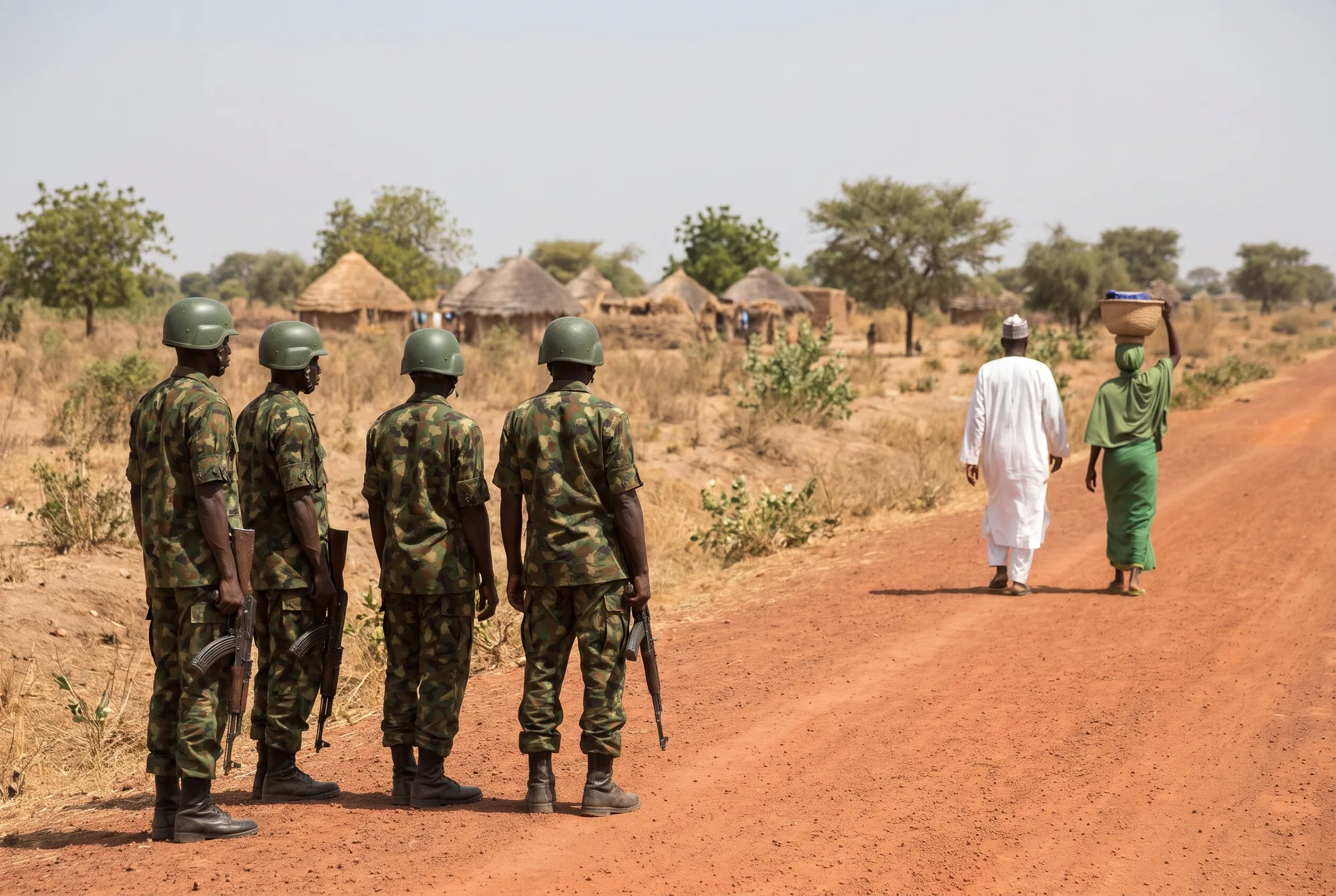
The President’s own framing is worth knowing. Speaking at the National Economic Council conference on 9 February 2026, President Bola Tinubu promised that Nigeria would defeat terrorism and banditry, calling both unacceptable and foreign to Nigerian culture. Plenty of Nigerians would agree with the sentiment. The harder question, and the one this article is really about, is why something so foreign has found so much room to grow at home.
Nigeria’s Main Armed Groups and What Drives Them
| Group | Type | Main area | Origin | 2025 toll (GTI 2026) | Main drivers |
|---|---|---|---|---|---|
| Boko Haram (JAS) | Jihadist insurgency | Borno, Mandara Mountains, Lake Chad | Founded 2002 by Mohammed Yusuf; armed revolt from July 2009 | 43 attacks, 213 deaths | Ideology, anger at the state after Yusuf’s death in custody, rural poverty |
| ISWAP | Jihadist insurgency | Borno, Sambisa Forest, Lake Chad Basin | Split from Boko Haram in 2016 | 92 attacks, 384 deaths | Islamic State backing, weak state presence in rural Borno |
| Lakurawa | Jihadist insurgency | North-West | Emerged 2024; proscribed 23 January 2025 | 10 attacks, 74 deaths | Spillover from the Sahel across the Niger border |
| Ansaru | Jihadist insurgency | Northern Nigeria | Announced January 2012 as a Boko Haram splinter | Not listed separately | Jihadist ideology |
| Bandit gangs (Yan Bindiga, Yan Ta’adda) | Criminal, declared terrorist in 2021 | Zamfara, Katsina, Kebbi, Kaduna, Sokoto | Farmer and herder clashes, turning to banditry around 2015 | Not listed separately | Ransom, cattle rustling, ungoverned forests, youth unemployment |
| IPOB | Separatist | South-East | Proscribed September 2017 | Not listed separately | Demand to restore the defunct Biafra |
The table shows why one solution cannot fit all three types: the jihadist groups dominate the official terrorism count, but the bandit gangs, which the index does not break out, touch far more households through kidnapping. Any honest answer about causes has to cover ideology and money at the same time.
The Short Answer: What Are the Causes of Terrorism in Nigeria?
If you remember one paragraph from this article, make it this one. The causes of terrorism in Nigeria are a combination of extremist ideology, carried by Boko Haram, ISWAP, Ansaru and Lakurawa and fed by networks across the Sahel; deep poverty and unemployment, concentrated in the North, where 65 per cent of the country’s multidimensionally poor live; weak governance and the near absence of the state in large rural areas, which lets armed groups tax, judge and recruit; abuses and impunity by security forces, which turn grievance into anger; a ransom economy worth about ₦2.23 trillion in a single year, which makes violence profitable; porous borders with Niger, Chad and Cameroon that let fighters and weapons move freely; and, in the South-East, separatist demands for Biafra. Closely linked to these are millions of out-of-school children, farmer and herder clashes over land, and politicians who manipulate armed groups for their own ends.
In short, the six causes most often cited by researchers and officials are:
- Extremist ideology and Sahel networks
- Poverty, unemployment and out-of-school youth
- Weak governance and ungoverned rural spaces
- Security force abuses and impunity
- The ransom economy
- Porous borders and arms trafficking
None of these causes works alone. A poor young man in a village with a school, a clinic, a police post and a job does not usually pick up a rifle. Remove three of those four and the recruiter’s pitch suddenly sounds less mad.
What Causes People to Become Terrorists in Nigeria?
Causes at the level of a country are one thing. But every attack is carried out by individuals. What tips a particular young man (and occasionally a young woman) into an armed group?
The most striking answer comes from a 2023 United Nations Development Programme study, cited in the Global Terrorism Index 2026. Looking at recruits across sub-Saharan Africa, it found that 71 per cent cited human rights abuse by state security forces as the tipping point that made them join. About a quarter cited a lack of job opportunities. Read that again. For most recruits, the final push was not a sermon or a pay packet but something done to them, or to their father or brother, by people in uniform.
That fits what Nigerians themselves say. A 2018 study in the journal Perspectives on Terrorism by Adesoji Adelaja, the late Abdullahi Labo and Eva Penar found that most respondents named unemployment, poverty and economic problems, dislike for government, extreme political ideology, extreme religious feelings and manipulation by some politicians as root causes of Boko Haram. Notice how few of those are about religion alone.
Education is the next piece. UNICEF’s 2025 State of Nigeria’s Children report puts the number of out-of-school children at 10.2 million of primary-school age and 8.1 million of secondary-school age, and a Leadership editorial, citing UNICEF, says most of them are in the North-East and North-West. Researchers have long warned that some almajiri children, sent away to Qur’anic teachers and left to beg for their food, become easy targets for recruiters. They are victims first, and treating them as suspects hands the recruiters another grievance.
Then there is money. At the end of January 2026 the Nextier think tank published a report called The Ransom Economy, arguing that kidnapping in Nigeria now runs as an organised system with set prices, specialised roles and local supply chains, and that banditry employs thousands of young men who would otherwise be idle. Every ransom paid tells the next gang that the crime works. With about one young Nigerian in six neither working, studying nor training, a motorcycle, a rifle and a share of a ₦2.67 million ransom can look like a career.
Governance failure ties it all together. Nnamdi Obasi, Senior Adviser on Nigeria at the International Crisis Group, told The Guardian that poverty and unemployment have created “a large pool of young people who have no livelihood and no hope”, and that failure to punish the perpetrators of atrocities has created an atmosphere of impunity. When nobody is jailed for burning a village, the next village burns too.
Coercion matters as well, because armed groups punish communities that refuse them. The massacre at Woro in Kwara State on 3 February 2026, which killed at least 170 people by Al Jazeera’s count, shows how this works. President Tinubu said the gunmen targeted villagers who had rejected efforts to impose hardline rule, and Governor AbdulRahman AbdulRazaq called it a frustrated response to military operations in the state.
Finally, a word of caution. When attacks are blamed on a whole ethnic group, the people who suffer are ordinary herders and traders, and the real gunmen gain a recruiting line. I have written separately about how stereotypes of Fulani people spread, and that history is worth knowing before forwarding the next angry voice note.
The government’s counter-terrorism coordinator says much the same thing. At an ECOWAS conference in Abuja reported by Johnson Eyiangho, Major General Adamu Laka argued that lasting peace depends on dealing with what drives the violence, through dialogue, education, livelihoods and community resilience alongside military action. On that point, the critics and the government are not as far apart as the headlines suggest.
What Are the 7 Signs of Terrorism Nigerians Should Know?
Understanding causes is the long game. In the short term, attacks are planned, and planning leaves traces that ordinary people often see before the security services do.
The “seven signs of terrorism” is a checklist used for years by American security agencies, including the US Air Force’s Eagle Eyes programme. Some versions add an eighth sign, funding. In an opinion piece published in December 2025, Abiodun Ramon Oseni, a Fellow at the Institute of Security Nigeria, set out eight indicators adapted for Nigerian communities, from strangers studying a village’s daily routine to people buying several “burner” phones.
Here is a practical seven-step version for a Nigerian school, church, mosque, market or motor park, with what to do at each stage:
- Notice surveillance. Someone filming the school gate, sketching the layout of a church compound or noting when the market is busiest may be studying a target, so write down the time, the place and a description, and do not confront the person.
- Watch for odd questions. A visitor who asks how many pupils sleep in the hostel, when the guards change shift or which road the pastor or imam uses home is gathering information, so tell your head teacher, chairman or community leader the same day.
- Spot tests of security. A bag left unattended to see how fast anyone reacts, or a stranger who keeps wandering into restricted areas, is often a rehearsal of your response, so report it even if nothing happens.
- Note unusual purchases. Several new SIM cards or cheap phones bought at once, large quantities of fertiliser out of season, or uniforms changing hands are worth mentioning to the police, because terrorists need supplies before they act.
- Pay attention to people out of place. A “policeman” in an ill-fitting uniform, or someone claiming to work for a company nobody has heard of, may be impersonating officials, so ask for identification politely and report your doubts.
- Recognise dry runs. The same motorcycles passing the same compound at the same hour, or a group walking the route between the road and the school dormitory, can be a practice run, so record dates and times as a pattern.
- Act at once when people and supplies move into position. This is the last chance to stop an attack, so call the toll-free 112 emergency number, which the National Counter Terrorism Centre activated for reporting suspicious activity and kidnapping in February 2025, and give exact landmarks rather than vague directions.
Two habits make this list work. First, report to the authorities before you post on WhatsApp, because a rumour can cause a stampede while a quiet call can save lives. Second, as Oseni points out, the police should never ask you for money to take a report; if anyone does, that is a complaint in its own right.
Final Thoughts on the Causes of Terrorism in Nigeria
So, what are the causes of terrorism in Nigeria? They are an extremist ideology that turned violent in 2009 and never went away, a poverty gap that leaves most of the North’s young people with too little to lose, a state that is absent from too many villages, security forces whose abuses become recruiting posters, a ransom trade worth more than ₦2 trillion in a single year, and borders that let the Sahel’s wars walk in.
That list can feel overwhelming. It should also feel hopeful, because every item on it is something people can change. Ideology needs recruits, and recruits come from classrooms that were never built and courts that never sat. Fix enough of those, which is what the National Counter Terrorism Centre now says it is trying to do alongside military operations, and the fire starts to run short of fuel.
Your part is smaller than the government’s, but it is real. Know the warning signs, keep the 112 number in your phone, refuse to blame whole tribes or faiths for the crimes of armed men, and judge every politician’s security promise by whether it reaches the villages, not just the headlines.
- Ask your state and local government representatives what they are doing about out-of-school children in your area, and follow up in writing.
- Support local peace and reintegration work through your church, mosque or community association rather than leaving it to Abuja.
- Check the source of any attack story before sharing it, and never forward claims that blame an entire ethnic or religious group.
Related Articles
Terrorism is only one strand of a wider story, and my explainer on why there is a crisis in Nigeria steps back to look at the economic, political and security pressures that feed one another, including the regional indicators that show where the strain is greatest.
If you want to see where insecurity sits among everything else Nigerians are worried about right now, my guide to the current issues in Nigeria sets it beside petrol prices, food inflation, wages and the run-up to the January 2027 election.
Key Takeaways
- Nigeria ranked fourth on the Global Terrorism Index 2026, with 750 terrorism deaths in 2025, up 46 per cent, and Borno accounting for 72 per cent of them.
- The causes combine jihadist ideology, Northern poverty, weak governance, security force abuses, porous borders and a ransom economy estimated at ₦2.23 trillion in one year.
- Recruitment is driven less by religion than by grievance, joblessness and impunity, so lasting solutions must pair security operations with schools, jobs and justice.
Frequently Asked Questions: What Are the Causes of Terrorism in Nigeria?
What are the causes of terrorism in Nigeria?
The causes of terrorism in Nigeria are extremist ideology, deep poverty and unemployment in the North, weak governance in rural areas, abuses and impunity by security forces, porous borders and a ransom economy worth about ₦2.23 trillion in a year. In the South-East, the separatist demand to restore Biafra adds a third kind of violence.
What are the main causes of terrorism?
Around the world, terrorism is usually driven by a mix of political or religious ideology, grievance against the state, poverty and exclusion, and conflict that leaves areas without government control. A 2023 United Nations Development Programme study, cited in the Global Terrorism Index 2026, found that 71 per cent of recruits in sub-Saharan Africa named abuse by state security forces as the final push to join.
How was terrorism started in Nigeria?
Modern terrorism in Nigeria began with Boko Haram, which Mohammed Yusuf founded in 2002 and which turned violent in July 2009, when clashes left more than 800 people dead and Yusuf died in police custody. The group then went underground under Abubakar Shekau and returned as an armed insurgency.
What caused the war on terrorism?
The global war on terrorism was launched by the United States after the al-Qaeda attacks of 11 September 2001. Nigeria’s own campaign began in 2009 in response to Boko Haram, and the National Counter Terrorism Centre now coordinates it under the Terrorism Prevention and Prohibition Act of 2022.
Who started Boko Haram in Nigeria?
Boko Haram was founded in 2002 by Mohammed Yusuf, a preacher in the North-East who opposed Western education. After he was killed in police custody in July 2009, leadership passed to Abubakar Shekau, and the movement later split into JAS and ISWAP.
Is banditry terrorism in Nigeria?
Yes, legally it is, because the Federal High Court in Abuja declared the Yan Bindiga and Yan Ta’adda bandit groups and similar gangs to be terrorists on 25 November 2021. The government then published the proscription in its official gazette.
Is terrorism in Nigeria caused by religion?
Religious extremism is one driver, but most recruits and researchers point to poverty, unemployment, anger at the government and abuses by security forces as well. Jihadist groups also attack Muslims who reject their rule, so the violence is not simply Muslims against Christians.
Which state is most affected by terrorism in Nigeria?
Borno State is the most affected, with 67 per cent of terrorism attacks and 72 per cent of terrorism deaths in Nigeria in 2025, according to the Global Terrorism Index 2026. Zamfara, Katsina, Kebbi, Sokoto and Niger State also suffer heavily from bandit and jihadist violence.
What is Nigeria’s rank on the Global Terrorism Index?
Nigeria ranked fourth in the world on the Global Terrorism Index 2026, up two places from sixth the year before. Terrorism deaths rose by 46 per cent to 750 in 2025, the highest toll since 2020.
How much ransom do Nigerians pay to kidnappers?
The National Bureau of Statistics estimated that households paid about ₦2.23 trillion in ransom between May 2023 and April 2024, with an average payment of ₦2,670,693. About 65 per cent of households that suffered a kidnapping paid a ransom.
What number do I call to report terrorism in Nigeria?
Call 112, the free national emergency number that the National Counter Terrorism Centre activated in February 2025 for reporting suspicious activity, crime and kidnapping. Give your exact location with landmarks, and do not confront the suspects yourself.
How can terrorism in Nigeria be stopped?
Terrorism in Nigeria can be reduced by pairing military and police action with schools, jobs, justice for victims and an end to abuses by security forces. Cutting off ransom money, securing the borders and restoring government services in rural areas are just as important as winning battles.