 Get Guardian on Google
From transforming rail transportation and road infrastructure to improving healthcare, education, jobs creation and economic development in Lagos State, Governor Babajide Sanwo-Olu’s record in office could provide his Deputy, Obafemi Hamzat, who is the governorship flag bearer of the All Progressives Congress (APC) in the forthcoming 2027 elections, a formidable campaign edge against his ONYEDIKA AGBEDO opponents, writes.
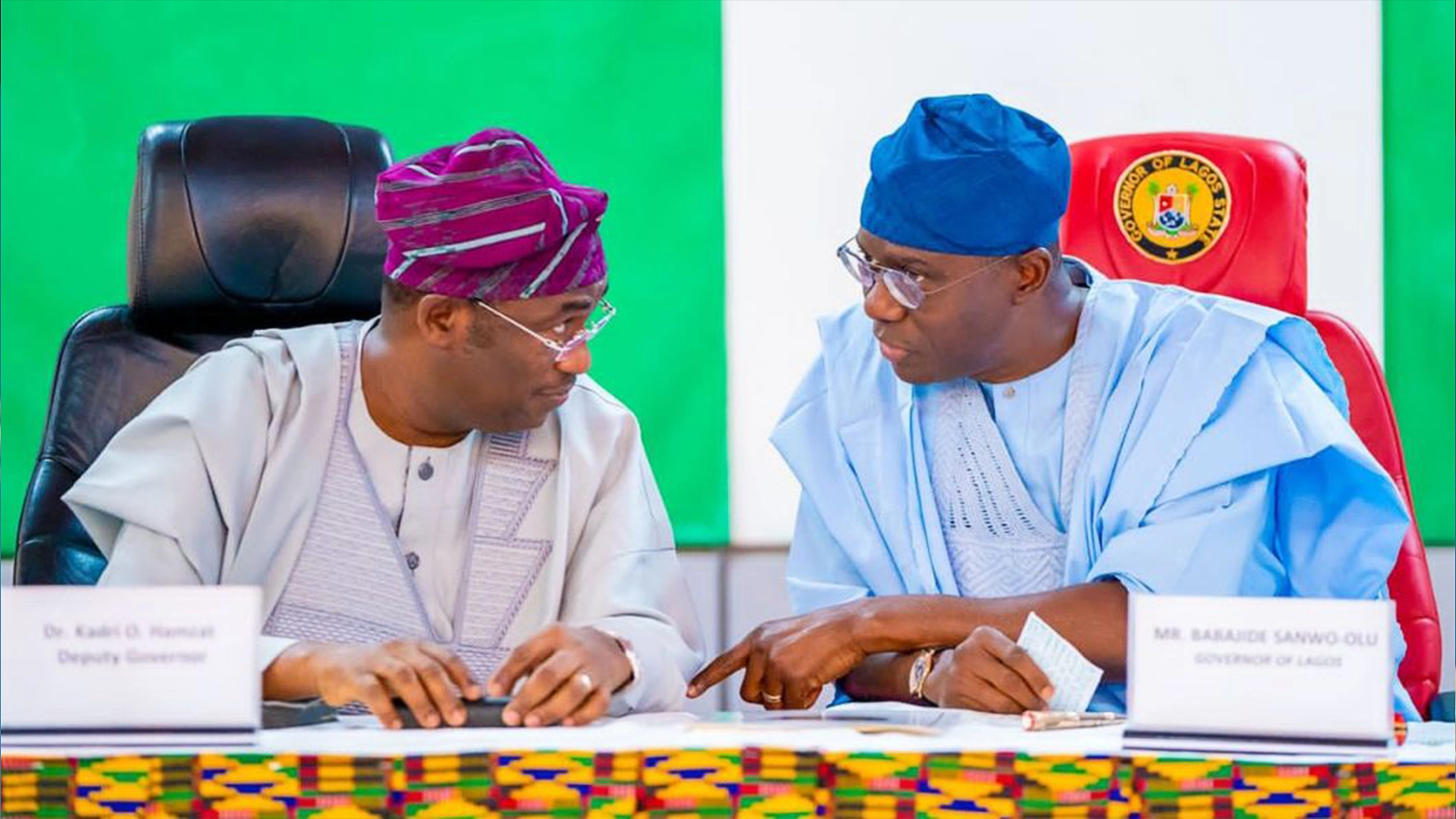
The most politically consequential moment of Governor Babajide Sanwo-Olu’s crowded last week of October did not come during his engagement with investors, his economic presentation in Abuja or his address to some of Nigeria’s leading bankers. It came on Friday, October 30, when he endorsed his deputy, Dr. Kadri Obafemi Hamzat, as his preferred successor in the 2027 governorship election.
At the unveiling of Hamzat’s manifesto at the Wole Soyinka Centre for Culture and Creative Arts, Iganmu, Sanwo-Olu revisited their political relationship, particularly Hamzat’s decision to step aside during the contest for the Lagos State All Progressives Congress (APC) governorship tiecket in September 2018.
The governor recalled how their relationship had evolved into a working partnership, repeatedly insisting that Hamzat was “in the room” when critical decisions were taken, including those concerning the COVID-19 response and infrastructure development.
Beyond personal loyalty, the argument was about experience, institutional knowledge and continuity. Sanwo-Olu was presenting his deputy as someone who understood the workings of government and had participated in shaping its policies.
For Hamzat, however, the more substantial opportunity lies in presenting the Sanwo-Olu administration’s record to Lagos voters as evidence of what another four years under the APC could offer.

That record provides campaign talking points in transportation, road infrastructure, healthcare, education, enterprise development and the digital economy. But it also comes with unfinished projects and persistent social challenges that the candidate must address.
Since assuming office in 2019, Sanwo-Olu and Hamzat have presided over substantial investment in Lagos infrastructure. The completion and commencement of operations on the Blue and Red rail lines are among their most visible achievements.
The Blue Line began commercial operations in September 2023, while the Red Line was commissioned in February 2024. Both projects offer alternatives to road transportation in a city where congestion continues to affect productivity and residents’ quality of life.
Government figures put passenger patronage on the two rail lines at nearly 11 million, while theBus Rapid Transit (BRT) system is credited with more than 700 million passenger journeys.
The Lekki Deep Sea Port, although conceived and developed before the present administration, also became operational during its tenure, strengthening Lagos’ position as a major commercial and maritime centre.
The administration has also recorded interventions in road infrastructure. Government figures indicate that 362 roads, covering approximately 347 kilometres, have been completed since 2019.
These projects provide Hamzat with evidence of physical development to present during the campaign. However, their political value will depend on how residents experience them, particularly in terms of affordable transportation, reduced commuting time and improved access to neighbourhoods.
Healthcare is another area where the administration can point to measurable interventions. Its Ilera Eko health insurance scheme has expanded towards a membership target of two million, while investments in medical facilities have continued. The ongoing construction of Massey Children’s Hospital, with a proposed 150-bed capacity; Ojo General Hospital, with 280 beds and Somolu General Hospital, with 150 beds, is expected to expand access to medical services.
The Lagos Private Health Plans, launched during the week, also seeks to widen health insurance coverage, with mandatory enforcement scheduled for January 1, 2027.
For Hamzat, these initiatives provide an opportunity to demonstrate how he intends to improve healthcare access, complete ongoing projects and make medical services more affordable.
Education and employment are equally important components of the administration’s record. Through EKOEXCEL, the state has pursued technology-driven improvements in public primary education, covering more than 1,000 schools. Government figures also indicate that about 33,000 teachers have benefited from capacity-building initiatives.
The establishment of Lagos State University of Science and Technology and Lagos State University of Education in 2022 further expanded the state’s tertiary education landscape.
On employment and enterprise development, the Lagos State Employment Trust Fund and related interventions have provided financial and technical support to businesses. Government figures indicate that more than N15 billion has been disbursed to over 21,000 businesses.
The administration also cites the training of more than 116,000 people, including about 30,000 young people in digital and technology-related skills, while approximately 15,000 beneficiaries have been placed in employment. It also attributes more than 300,000 jobs to its broader employment and enterprise initiatives.
These interventions, alongside the establishment of 91 digital hubs, could help Hamzat frame his campaign around entrepreneurship, youth employment and Lagos’ ambition to become a technology and innovation hub.
Nevertheless, he must explain how these opportunities can be expanded to address the employment needs of a growing population, particularly amid rising living costs and pressure on small businesses.
The Significance Of A Crowded Week
It was against this background of achievements and continuing challenges that Sanwo-Olu’s activities during the last week of October acquired a political undertone.
On Monday, October 26, the governor participated in the 32nd Nigerian Economic Summit in Abuja, where he spoke on regional trade corridors, infrastructure and the African Continental Free Trade Area.
His intervention reflected Lagos’ position as a commercial gateway whose economic fortunes are closely connected to international trade, national economic policy and regional infrastructure.
Tuesday brought him back to the social responsibilities of the government. At the 26th National Women’s Conference of the Committee of Wives of Lagos State Officials (COWLSO), Sanwo-Olu acknowledged women’s contributions to leadership, entrepreneurship and community development.
The occasion also produced a widely discussed personal moment when he presented his wife, Dr. Ibijoke Sanwo-Olu, with a bouquet of flowers and kissed her publicly.
Beyond the gesture, the conference was significant because the 2026 edition was the last to be held under the present administration. At its conclusion on Wednesday, the governor urged COWLSO to ensure that its contributions survived beyond his tenure.
During the conference, Mrs. Francisca Olaitan Lawal, a retired teacher after 33 years of service, won a three-bedroom apartment, while Mary Odofin of the Lagos State Ferry Services emerged winner of an SUV.
Tuesday also featured the launch of the Lagos Private Health Plans, another initiative whose implementation will extend into the next administration.
On Wednesday, Sanwo-Olu turned to business confidence and investment. At the Nigerian-British Chamber of Commerce executive business breakfast, he outlined his administration’s vision for a more competitive Lagos economy, highlighting transportation, digital public services and infrastructure.
His subsequent meetings with the French Development Agency and CMA CGM addressed waterways transportation, electric ferries, maritime investment and the Lekki Deep Sea Port.
These discussions concerned partnerships and investments requiring long-term planning and institutional continuity. For Hamzat, they offer an opportunity to present himself as a candidate familiar with the state’s investment priorities. But familiarity with ongoing projects also means accepting responsibility for their completion.
Thursday brought fewer major publicly reported activities, leaving Friday’s political engagement as the week’s defining moment.
The Succession Argument
At Hamzat’s manifesto presentation, Sanwo-Olu recalled the succession of administrations from Bola Tinubu through Babatunde Fashola and Akinwunmi Ambode to his own, likening the process to a relay race in which each administration receives responsibility from its predecessor and passes it to the next.
The analogy was an argument for continuity, with Hamzat presented as the person best positioned to sustain Lagos’ development because of his participation in the present administration.
His manifesto, titled ‘The Lagos Promise (Ileri Eko),’ contains 100 commitments across seven policy pillars: People, Renewal, Opportunity, Machinery, Inclusion, Security and Resilience, and Everyday Dignity.
Among its proposals are increasing the number of buses from 1,000 to 4,000; expanding Ilera Eko towards covering one in every three Lagos residents; establishing 100 primary healthcare centres and improving maternal and child healthcare.
He has also promised to pursue major infrastructure projects, including the Fourth Mainland Bridge.
The manifesto provides a platform for Hamzat to build on the administration’s achievements while offering answers to areas where residents expect more substantial progress.
However, the distinction between completed achievements and campaign promises will be important. Hamzat must demonstrate that his proposals are practical, properly funded and capable of delivering measurable results.
The administration’s unfinished projects will also feature prominently in the campaign. The Fourth Mainland Bridge, for instance, has remained a recurring feature of successive Lagos development plans since the APC came to power in 1999. Its continued absence from the list of completed projects makes it a sensitive electoral issue.
The housing deficit, estimated at about 3.4 million units, equally presents a challenge, notwithstanding the administration’s housing schemes. Hamzat will have to explain how he intends to expand access to affordable accommodation in a city where housing costs continue to burden working families.
There is also the broader question of economic hardship. While the Sanwo-Olu administration can point to state-level investments, residents are contending with rising living costs arising partly from national economic policies, including fuel subsidy removal and currency depreciation.
Hamzat must distinguish the state’s achievements from the difficulties arising from national policies while explaining additional measures he would introduce to improve living conditions.
The remaining engagements on Friday brought other dimensions of the administration’s legacy into focus.
At the centenary celebration of the Medical Guild, Sanwo-Olu and his wife received recognition for their contributions to healthcare. The occasion also drew attention to continuing concerns about doctors’ welfare, medical facilities and the quality of healthcare delivery.
Later, at the Maltina Teacher of the Year Awards, Lagos teacher, Busayo Adeyemo, emerged national winner. Sanwo-Olu announced a three-bedroom apartment for her, in addition to prizes that included N10 million, a vehicle, professional training and an infrastructure project for her school.
Saturday maintained the week’s focus on economic development and investment. At the Chartered Institute of Bankers of Nigeria’s Fellowship Investiture, the governor urged banks to support productive enterprises and industrial growth. Hours later, he appeared on the Lagos Fashion Week runway for designer Ugo Monye, drawing attention to the state’s creative industry.
By Saturday night, the political significance of the governor’s activities had become clearer. His engagements demonstrated the breadth of responsibilities attached to the office, while his Friday endorsement of Hamzat brought the question of succession into sharper focus.
For the deputy governor, the Sanwo-Olu administration’s record presents both an opportunity and a responsibility. Its achievements in rail transportation, road infrastructure, healthcare, education, enterprise development and digital innovation could provide the foundation for a persuasive campaign for continuity.
But voters will also examine the cost of living, employment opportunities, housing affordability, security and unfinished projects.
Sanwo-Olu’s argument that Hamzat was ‘in the room’ when important decisions were taken may establish his experience and familiarity with government. The more consequential question is what he intends to do with that experience.
As the APC prepares to defend its 27-year hold on Lagos, the 2027 contest will be more than political loyalty or the succession preferences of an outgoing governor. It will be a referendum on the party’s development record, the benefits of continuity and whether Hamzat can convince residents that he has a better plan for the challenges that remain.
For Hamzat, the most persuasive argument may not be that he was present when decisions were made, but that he can demonstrate what those decisions have delivered to Lagosians and how he intends to build on them.