 Follow Us on Google News



 Follow Us on Google Discover
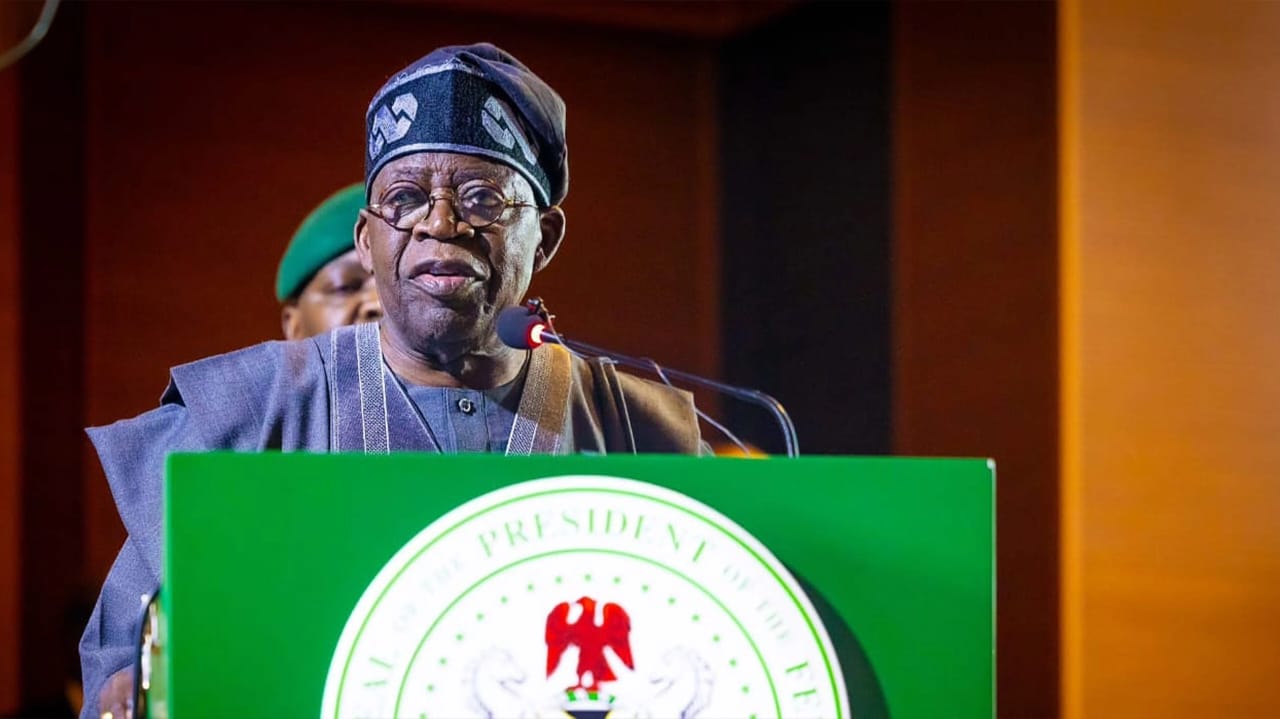
As the 2027 general elections draw closer, President Bola Ahmed Tinubu has urged Nigerians, particularly the youths to be weary of the nation’s unity and stability by being conscious of the peaceful coexistence that would ensure oneness of Nigerians beyond the exercise.
Tinubu, at the University of Ilorin (UNILORIN’s) 41st convocation ceremony, on Friday, urged Nigerian youths to participate peacefully and responsibly.
He warned them against political violence, intimidation, hate speech and misinformation.
According to Tinubu: “elections are not war. Democracy is a contest of ideas, not violence.”
He called on citizens to assess candidates on their records and programmes and to hold public office holders accountable through lawful means.
President Tinubu and Kwara State Governor, Mallam AbdulRahman AbdulRazaq shared same view on the need to strengthen tertiary education, research and youth development.

Represented by the Minister of State for Education, Prof. Suwaiba Said Ahmed, Tinubu highlighted his administrations’ interventions in education and the need to equip graduates with skills so as to contribute to national development.
Tinubu said education remained a strategic investment in Nigeria’s future, urging them to embrace innovation, entrepreneurship, lifelong learning and integrity.
He congratulated the graduating students of the Class of 2026, describing their certificates as instruments for solving problems, creating opportunities and serving humanity.
“In a world increasingly shaped by digital technology and artificial intelligence, I encourage you not only to seek employment, but also to create it,” he said.
The President commended the university for its reputation for academic excellence, institutional discipline, relative industrial stability and prudent resource management.
He also expressed satisfaction with its reported research achievements in areas including drug treatment and artificial intelligence-powered electrocardiogram testing.
Tinubu said the Federal Government would continue to support initiatives aimed at improving teaching and learning, expanding research capacity and preparing graduates to compete in an increasingly interconnected world.
He cited the Nigerian Education Loan Fund (NELFUND), the Tertiary Education Trust Fund (TETFund), the 3 Million Technical Talent Programme and the Student Innovation Challenge as interventions designed to expand access to education, strengthen infrastructure, develop digital skills and promote entrepreneurship.
According to him, figures available for August 2026 indicated that NELFUND had disbursed more than ₦322 billion to over 1.6 million students nationwide, comprising approximately ₦192 billion for tuition and institutional fees and ₦129 billion for student upkeep allowances.
The President also reaffirmed his administration’s commitment to industrial harmony in tertiary institutions, noting that the Federal Government had signed agreements with academic and non-teaching staff unions on the payment of the Consolidated Academic Tool Allowance (CATA) and the Consolidated Non-Teaching Tool Allowance (CONTA), effective from Jan. 1, 2026.
He described academic and non-teaching personnel as indispensable to the effective functioning of tertiary institutions, stressing that stable academic calendars, staff welfare and constructive engagement were essential to quality education.
The event also featured a convocation lecture by Sierra Leone’s Minister of Technical and Higher Education, Dr. Haja Ramatulai Wurie, who called for stronger collaboration between universities, governments and communities to translate academic research into practical solutions.
Delivering the 41st convocation lecture, titled “From Lecture Hall to Cabinet Room: The Journey from Academia to Public Leadership,” the Sierra Leone’s Minister of Technical and Higher Education, Dr. Haja Ramatulai Wurie, urged graduates to apply their knowledge to public service, policymaking and national development.
Wurie examined how academic expertise and scientific research could inform government decisions and produce practical solutions to societal challenges.
Drawing on her transition from academic research to government leadership, Wurie said effective policymaking required more than statistics, emphasising the need to combine quantitative evidence, qualitative insights, institutional realities and community experiences.
She cautioned against the reforms that addressed isolated problems without considering the wider systems responsible for producing them.
“A system produces outcomes through the interaction of its parts. This is why reforms must address bottlenecks, incentives and unintended consequences, not just isolated activities,” she said.
The minister highlighted Sierra Leone’s efforts to develop a national admissions system informed by Nigeria’s Joint Admissions and Matriculation Board (JAMB) Central Admissions System.
She explained that successful adoption required adapting relevant lessons to local realities rather than merely replicating another country’s model.
According to her, effective digital public services depend on coordinated procedures, reliable data, privacy safeguards, accountability and public trust, while also accommodating persons with disabilities and applicants in areas with limited internet connectivity.
“Technology is not the system by itself. People, rules, data, governance and support make it work,” she said.
Wurie called for stronger partnerships among universities, governments and communities to ensure research priorities reflected national needs and produced tangible benefits.
“Research capacity is national development capacity. Co-design the questions. Co-lead the work. Share the benefits,” she said.
Reflecting on her transition into public leadership, she said her academic background had remained central to her work in government.
Also, Governor AbdulRazaq said education remained a strategic priority of his administration and a foundation for sustainable development, social mobility, innovation and economic growth.
He congratulated the graduands and acknowledged the sacrifices of parents, guardians, lecturers and other individuals who contributed to their academic achievements.
In his convocation address, the Vice-Chancellor of the University of Ilorin, Prof. Wahab Olasupo Egbewole, urged the institution’s graduands and academic community to embrace progressive change while preserving the foundations of its achievements.
He said excellence must become an institutional culture rather than a slogan, adding that the university must continually improve its research capacity, institutional visibility and collaborations.
He challenged researchers to translate their findings into practical solutions to problems affecting food security, healthcare, affordable technology, education, manufacturing, environmental sustainability and public policy.
“Take your research beyond the thesis. Take your knowledge beyond the laboratory. Take your discoveries beyond the University gates,” he said.
The Pro-Chancellor and Chairman of the Governing Council, Surveyor Abiodun Aluko, commended the Federal Government for interventions aimed at improving tertiary education, particularly through TETFund and NELFUND.
He also praised the Staff Welfare and Housing Loan Schemes and the improved relationship between the government and university-based unions, including the Academic Staff Union of Universities (ASUU), Senior Staff Association of Nigerian Universities (SSANU), Non-Academic Staff Union (NASU) and National Association of Academic Technologists (NAAT).

