

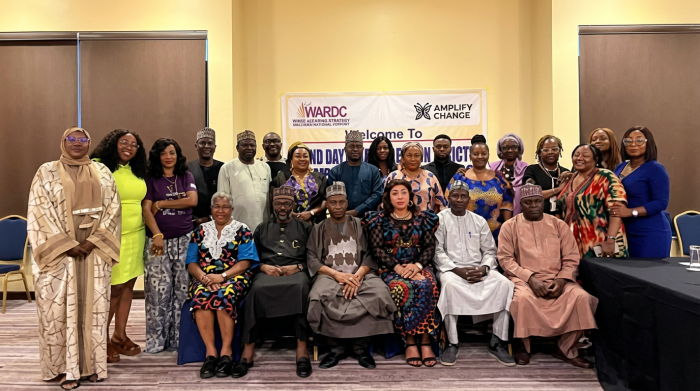
A policy-focused roundtable organised by Women Advocates Research and Documentation Centre (WARDC) in partnership with Amplify Change has renewed calls for urgent political, legal and financial reforms to address Nigeria’s persistent Sexual and Reproductive Health and Rights (SRHR) challenges and alarming maternal health indicators.
The high-level engagement convened policymakers, legislators and civil society actors to review developments in SRHR, conduct a situation analysis of maternal health in Nigeria, and identify why preventable deaths among women and girls remain widespread despite existing policies and laws.
Delivering a forceful intervention, Executive Director and Secretary of the Board of the Gender Equality Peace and Development Centre (GEPaDC), Professor Patricia Donli, said the core obstacle confronting SRHR implementation in Nigeria is not the absence of policy but the lack of political will and sustainable funding.
“When it comes to sexual and reproductive health and rights, a whole lot has been said already. What we are hoping to get from conversations like this with policymakers is what will actually change the narrative. For me, political will is critical.”
She stressed that policy commitments mean little without execution, pointing to chronic underfunding of the health sector. “There was the Abuja Declaration that said 15 per cent of the national budget should go to health. I don’t know if we have ever reached that. On paper you may hear 13 per cent, but what is actually released may be two per cent. Without health, we cannot achieve anything. Health is wealth.”
Donli questioned the credibility of a system where decision-makers are insulated from domestic healthcare realities through medical tourism. “The people at the top do not use the facilities in this country. Once they are sick, they travel. If there was a regulation that everybody must access healthcare here, within a short time, we would see serious improvement,” she argued.

She added that weak awareness, poor monitoring of health allocations and inconsistent regulation continue to undermine outcomes, warning that women are dying daily from preventable causes. “Women are dying minute by minute from issues that should not kill them. Governments must put structures in place so that no matter how poor you are, you can access healthcare and that comes with money,” she said, calling for stronger collaboration between government and civil society to track spending and demand accountability.
From the legislative arm, Speaker of the Gombe State House of Assembly, Muhammad Abubakar Luggerewo, said SRHR is treated as a serious governance issue in his state, particularly at the primary healthcare level.
“In Gombe State, most of these issues arise at the primary healthcare level, and the state has invested heavily in revitalising facilities across the 114 wards. In each ward, there are at least two well-equipped, functional primary health centres operating 24 hours, with power, human resources and everything required by global standards.”
Addressing concerns around women’s access to healthcare in northern Nigeria, Luggerewo said the perception that women are routinely denied care is exaggerated. “I do not see any man who will say his wife should not access health services. Health is a very serious issue,” he said, adding that Gombe State has “very robust and enabling laws” and is currently harmonising its legal framework to better address health and social issues.
He further positioned Gombe as a model for universal health coverage. “Our health insurance scheme is one of the best in the country. Other states are coming to study it, and I encourage them to even go beyond what we are doing,” he stated.
Offering a gender-responsive and rights-based perspective, Chief Whip of the Ogun State House of Assembly and Chair of the House Committee on Women Affairs, Bakare Omolola Olanrewaju, described the SRHR conversation as critical to national wellbeing.
“This conversation is very important for us as a nation. We need to create more awareness and even introduce this education early, maybe from the teenage years, because it can happen to anyone our children, our families, anybody.”
Olanrewaju, who is a trained nurse, said her background has shaped her legislative priorities. “Healthcare is very important to me because I am a nurse. Even though I am a politician now, I will forever be a nurse,” she said, outlining constituency-level interventions including building a health centre and providing health insurance for residents.
On the contentious issue of safe termination of pregnancy, she was unequivocal. “We have rape, incest, insecurity and exploitation, yet the law says you cannot terminate a pregnancy. That is what we need to change. Law is not something that cannot be amended. A woman who was raped should not be forced to carry a pregnancy that will destroy her mental health.”
She appealed directly to national lawmakers, noting the gender imbalance in the Senate. “Men do not go through pregnancy or childbirth. That is why we need women in positions of power to speak for women. I would beg the Senate President to look into this issue we do not want to keep losing our mothers and daughters.”
From Jigawa State, a member of the State House of Assembly, Haruna Aliyu, said the state has taken legislative steps to protect women and children. “We have the Violence Against Persons Law, the Child Rights Act and other laws. When you violate the rights of a child or a woman, such as rape, the penalty is very severe,” clarifying that these provisions exist within the state’s formal legal framework.
Aliyu explained that the legislature’s role is to make laws and ensure effective oversight. “Once we finish our work, the executive signs, sometimes within days, and the Ministry of Justice and relevant committees monitor implementation,” adding that while no new SRHR-specific bills are currently before the House, related legislation is undergoing committee review.
The roundtable ended with a consensus that Nigeria’s maternal health and SRHR crisis is fundamentally a governance issue. Participants agreed that without genuine political will, adequate financing, humane and harmonised laws, and sustained accountability, preventable maternal deaths will continue to undermine national development and human rights commitments.
