

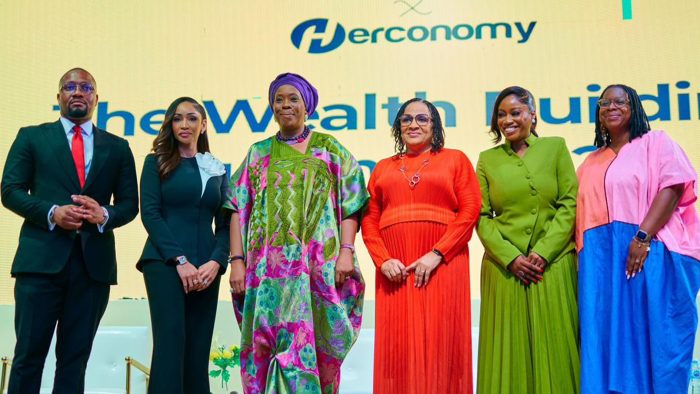
Stakeholders have called for deliberate policies, improved access to finance and stronger institutional support to drive inclusive economic growth, particularly for women and small businesses, amid rising economic pressures.
This call formed a central focus of discussions at this year’s Herconomy Wealth Building Summit held in Lagos, where policymakers, development partners and financial experts examined barriers to wealth creation and long-term financial stability.
Delivering the keynote address on behalf of Lagos State Governor, Babajide Sanwo-Olu, the Commissioner for Commerce, Cooperatives, Trade and Investment, Folashade Ambrose-Medebem, said the focus on wealth building for women reflects a shift from participation in the economy to ownership and long-term asset creation.
In the Governor’s address, she noted that inclusive growth requires expanding access to finance, skills and enterprise support, stressing that women remain central to economic growth and social stability. The address highlighted government interventions, including enterprise development programmes providing grants, low-interest loans and business support services to support small businesses.
The address also outlined efforts to expand skills acquisition and digital capacity, strengthen financial inclusion through partnerships with financial institutions and fintech platforms, and support women in underserved communities through targeted programmes.
In her opening remarks, founder of Herconomy and convener, Ife Durosinmi-Etti, said the platform is focused on building financial knowledge and confidence among women to enable informed financial decisions and wealth creation.
She stated that the organisation is working towards supporting 10 million African women to achieve financial independence, emphasising the need to move women from income generation to investment and asset ownership through access to financial tools and opportunities.
“It is about creating a future where women are not just part of the economy, but leaders, investors, and wealth creators,” she said.
She stressed that choosing and supporting Herconomy goes beyond individual benefit, explaining that every user engagement directly impacts another woman.
According to her, when people invest or support the platform, they are enabling women to access grants, build wealth for the first time and secure better financial options for how they live, earn and protect their families. She also urged participants to take immediate action by engaging with the platform’s offerings, particularly the wealth builder savings challenge.
Earlier, the Director-General of the Small and Medium Enterprises Development Agency of Nigeria (SMEDAN), Charles Odii, highlighted the scale and importance of small businesses to the Nigerian economy, noting that there are about 39.6 million nano, micro, small and medium enterprises in the country.
He said a significant proportion about 72 per cent are owned or led by women, underscoring the need for policies that reflect their realities and support their growth.
Odii added that the agency is in the process of reviewing the national MSME policy, with a focus on addressing structural constraints and incorporating feedback from entrepreneurs.
On the broader economic outlook, Chief Economist, Chinwe Egwim said while inflation appears to be easing, the effect has yet to translate into real relief for households.
She noted that many Nigerians continue to experience financial strain as income growth lags behind rising costs;” adding that expenses in key areas such as food, transportation and education remain elevated.
Also speaking, the Deputy Public Affairs Officer of the U.S. Consulate General in Lagos, Amanda Roach, said the United States is strengthening economic partnerships with Nigeria to support trade, investment and women’s economic participation.
She noted that Africa represents a major global economic opportunity, with a projected population of 2.5 billion people and purchasing power estimated at $16 trillion by 2050. Roach added that initiatives such as the Academy for Women Entrepreneurs and the African Growth and Opportunity Act are designed to support business growth, expand market access and create jobs.
Speaking on the role of women in economic development, the Ambassador of the Federal Republic of Nigeria to Austria, Dr Florence Ajimobi, said limiting opportunities for women undermines national growth.
Similarly, Co-Founder Noella Foundation, Layal Tinubu said access to capital, financial tools and information remains a major challenge in developing economies, noting that structured support systems are essential for sustainable growth.
Country Manager and Cluster Head, MasterCard, Dr. Folashade Femi-Lawal, emphasised that beyond earning income, building sustainable wealth requires structure, discipline and intentional financial decisions.
