

…introduces education index to tackle affordability crisis in Lagos schools
95.3 per cent of students in low-cost schools struggle to pay fees. 72.7 per cent drop out due to family relocation, while 47.7 per cent leave school because they simply cannot afford to stay. Nearly half, 45.7 per cent battle basic reading proficiency.
These stark figures framed a pivotal conversation on education equity in Lagos as the Call To Love Initiative marked its 15th anniversary with the launch of the Affordable and Inclusive Education Index (AIEI), a data-driven tool designed to influence policy and improve outcomes for children in underserved communities.
Speaking at the event held in Ikoyi, Lagos, founder of the initiative, Omowunmi Akingbohungbe, said the organisation’s journey over the past decade and a half has been anchored on a simple but urgent belief that every child deserves access to quality education, regardless of socio-economic background.
“Fifteen years ago, this work began with a conviction that every child, regardless of circumstance, deserves access to dignity, opportunity, and quality education. Today, we are not just celebrating impact; we are defining what comes next.”
Over the years, the initiative has worked across underserved communities in Lagos, delivering mentorship programmes, scholarships, and teacher development initiatives aimed at keeping children in school and improving learning outcomes. Its interventions have also extended to strengthening low-cost school systems through training and professional development for educators.

Akingbohungbe noted that while these interventions delivered impact at the grassroots level, a major gap persisted the absence of structured, usable data to inform large-scale decision-making.
“We were collecting insights from communities and schools, but there was no consistent way to translate these realities into evidence that could shape policy, that is why we built the Education Observatory to ensure our work is not just responsive, but evidence-informed.”
The Observatory, she said, has now evolved into the AIEI, a framework that measures affordability, accessibility, and inclusion in education, particularly within low-cost schools that serve a significant proportion of children from low-income households.
Findings from the pilot phase in Lagos Districts 3 and 4 reveal a system under pressure, but also one demonstrating resilience. Despite low tuition ranges between ₦13,000 and ₦45,000 per term, 86 per cent of schools still provide scholarships or fee reductions to support struggling families. However, infrastructure deficits remain critical, with 87.8 per cent of schools lacking science laboratories.
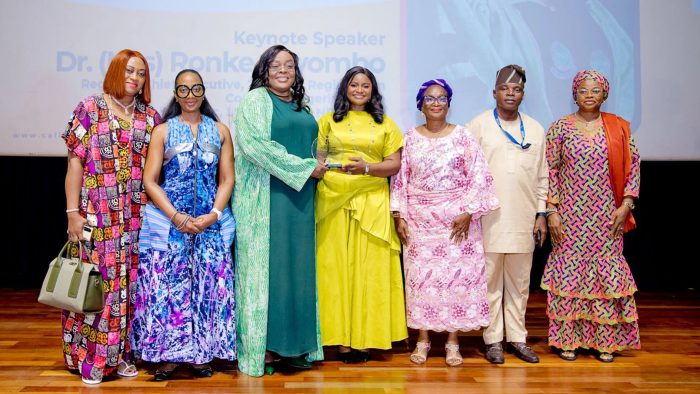
Delivering her keynote, Registrar and Chief Executive of the Teachers Registration Council of Nigeria (TRCN), Dr. Ronke Soyombo, described the initiative as a critical bridge between grassroots realities and national education reform efforts.
“We cannot fix what we cannot measure. By creating a community-focused research platform, this initiative is providing the eyes that our education system needs. This data will not sit on a shelf, it will drive evidence-based decision-making in Lagos State and beyond.”
She emphasised that the initiative aligns with federal priorities on human capital development, particularly in ensuring equitable access to quality education and strengthening teacher capacity.
Highlighting ongoing reforms, Soyombo noted that while teacher certification will become mandatory by 2027, affordability remains a major barrier for many educators. According to the AIEI findings, 61.5 per cent of teachers in surveyed schools are uncertified, yet 93.3 per cent are willing to obtain certification.
Beyond policy and data, the human impact of the initiative remains central. From children gaining access to education for the first time, to teachers improving their capacity, stakeholders say the ripple effects are visible across communities.
Soyombo commended the initiative for going beyond academics to support holistic child development. “You are not just developing literacy and numeracy; you are developing the whole child. What we see here proves that quality learning can happen anywhere, not just in elite schools.”
