 Follow Us on Google News
 Follow Us on Google Discover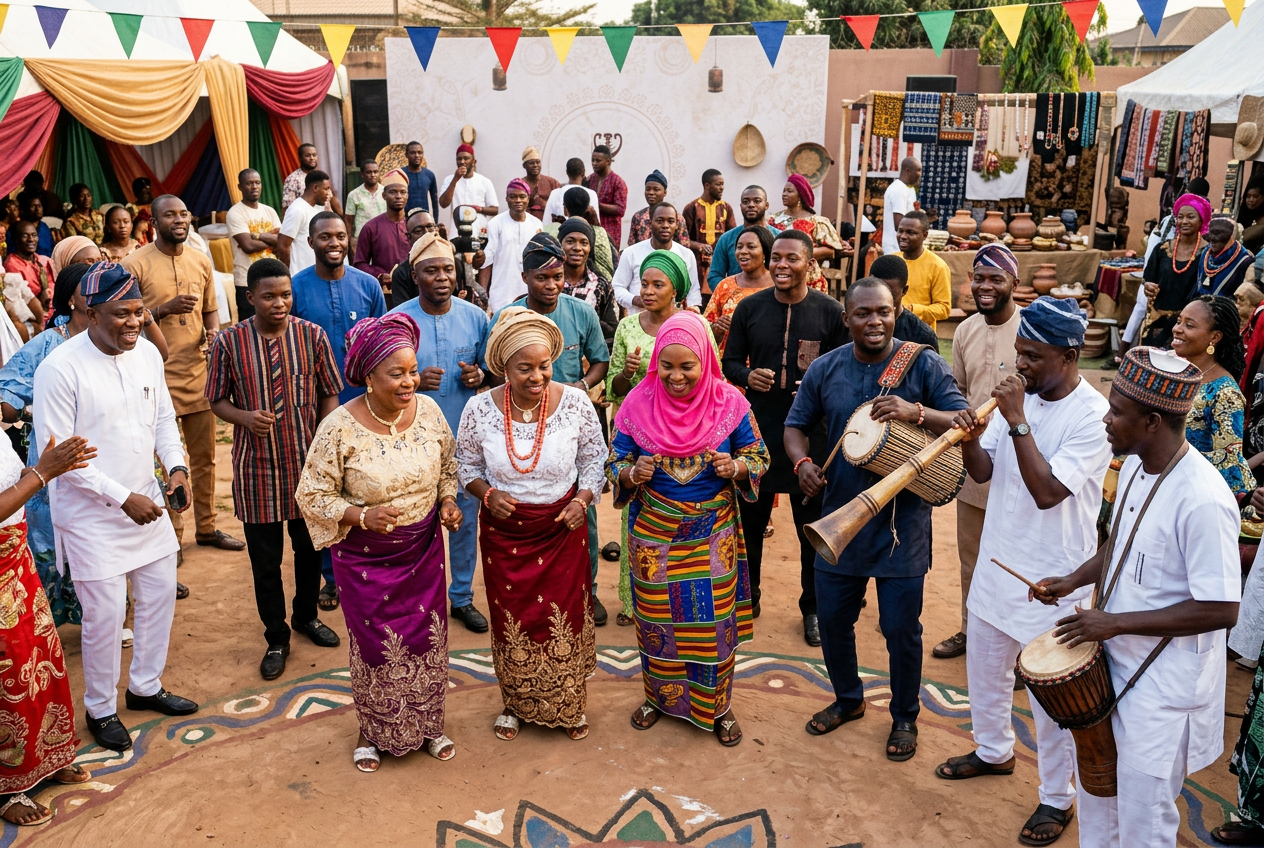
Hello, and thank you for stopping by. This piece is the result of months of research, dozens of conversations across markets, compounds and palace forecourts, and years spent writing about how Nigerians actually live rather than how brochures say we live. If you have come here asking what is the main culture in Nigeria, I want to give you a straight answer early and then spend the rest of our time together showing you why the honest answer is more interesting than the tidy one. There is no single main culture. What exists instead is a set of large regional cultures sitting inside a shared national character that anthropologists have mapped in detail, and learning to see both layers at once is the whole trick.
I learnt that lesson the hard way, incidentally, at a naming ceremony in Warri where I confidently used a Yoruba greeting on an Urhobo elder. He was gracious. His grandchildren were not.
What is the culture of Nigeria at its foundation?
Start with the numbers, because they explain everything that follows.
Nigeria recognises 371 ethnic groups and more than 500 living languages, which is an astonishing figure for one country. The Federal Ministry of Foreign Affairs sets out the basic composition on its official profile of the Nigerian population, noting that the Hausa in the north, the Yoruba in the south west and the Igbo in the south east each account for roughly a fifth of the country, with English serving as the common working language and the population split fairly evenly between Muslims and Christians.
Those three groups get the headlines. They do not get the whole story.
The other 368 groups include the Ijaw of the creeks, the Tiv of Benue, the Efik and Ibibio of the coastal south east, the Kanuri of Borno, the Nupe of Niger State, the Edo of the old Benin Kingdom, and the many communities of the Middle Belt whose names rarely reach international coverage but whose festivals, marriage rites and land customs are every bit as developed. Roughly a third of Nigerians belong to none of the big three. That is more people than live in most European countries, which is worth sitting with for a moment before anyone declares a winner.

So the culture of Nigeria, at foundation, is a federation of cultures rather than one culture with regional accents. Rather like a compound house where each family keeps its own kitchen but everyone shares the courtyard, the water tank and, inevitably, the arguments.
And what a courtyard it is.
The National Council for Arts and Culture, established by decree in 1975 and now the federal body responsible for coordinating this whole inheritance, describes its mandate on the council’s official site as indexing and presenting the living arts of the country, from crafts and textiles to cuisine, festivals, dances, folklore and indigenous games. Its flagship National Festival of Arts and Culture, NAFEST, exists precisely because nobody could agree on a single culture to showcase, so the state showcases all of them in rotation instead.
The five elements of culture in Nigeria that shape everyday life
When people ask about the five elements of culture in Nigeria, they are usually reaching for a framework, and the standard anthropological five work well here: language, religion, social organisation, customs and traditions, and material culture including arts and food. Let me take them in turn, because each one behaves slightly differently in Nigeria than the textbook suggests.
Language is the deepest divider and the most creative unifier. Over 500 tongues, three regional giants, English as the official language, and Nigerian Pidgin doing the actual heavy lifting in markets, motor parks and group chats from Kano to Calabar. Pidgin is the closest thing we have to a genuinely national vernacular, and it belongs to nobody, which is exactly why everybody uses it.
Religion organises the calendar. Roughly half the country is Muslim and concentrated in the north, roughly half is Christian and concentrated in the south, and indigenous belief systems run beneath both in ways that surprise visitors who expect neat categories. A Lagos family may attend a Pentecostal service on Sunday morning and pour libation at a burial on Saturday without experiencing any contradiction whatsoever.
Social organisation is where Nigeria diverges most sharply from Western expectations. Age matters. Seniority matters. Extended family matters enormously, and the word “cousin” is doing work here that English simply was not built for. The National Institute for Cultural Orientation, whose work on reviving the cultural sector is documented across its publications on cultural development, exists in part to keep these organising principles legible to younger urban Nigerians who did not grow up in the village that produced them.
Customs and traditions are the visible layer: naming ceremonies on the eighth day, bride price negotiations, chieftaincy titles, masquerade outings, burial rites that can run for a week.
Material culture is the layer the world buys. Ankara and aso-oke, agbada and babban riga, jollof and egusi and suya, Nok terracotta and Benin bronzes, talking drums and Afrobeats.
Five elements. Three hundred and seventy one variations. You begin to see the scale of the question.
How to read Nigerian culture correctly in your first month
If you are new to the country, or Nigerian by passport and returning after years abroad, this is the sequence I recommend to everyone who asks. It has saved me more embarrassment than I care to admit.
- Establish the local ethnic context before you open your mouth. Ask which group predominates in the town you have entered. Warri is not Benin City, and Jos is not Kaduna.
- Learn three greetings in the local language. Good morning, thank you, and a respectful form of address for an elder. Nothing else buys goodwill this cheaply.
- Watch how younger people greet older people, then copy it exactly. In Yoruba areas that may mean prostrating or kneeling. In Igbo areas a slight bow and a two-handed handshake. Copy, do not improvise.
- Accept the food. Refusing hospitality is read as rejection of the household, not as dietary preference. Take a little even if you are not hungry.
- Budget for ceremonies properly. Aso-ebi fabric for a wedding commonly runs from ₦25,000 to ₦90,000 per person, and a gift envelope at a naming ceremony rarely goes below ₦10,000 in urban areas.
- Keep religion respectful and low key until you know the room. Ask, do not assume, and never rank one faith above another in company.
- Attend one major festival before you form any opinion at all. Nothing on paper prepares you for the real thing.
Follow those seven and you will be forgiven almost anything else.
So, what is the main culture in Nigeria, exactly?
Here is the direct answer, in one paragraph, as promised.
There is no single main culture in Nigeria, but if the question means which culture is largest and most nationally visible, the honest reply is that three dominant cultures share that position: Hausa-Fulani in the north, Yoruba in the south west and Igbo in the south east, together making up roughly 60 to 68 per cent of the population, with the Hausa-Fulani the largest single bloc by numbers and the Yoruba and Igbo dominating the country’s cultural and commercial exports respectively. Above and across those three sits a genuinely national culture that every Nigerian participates in regardless of ethnicity, built from Nigerian Pidgin, Nollywood, Afrobeats, jollof rice, the Super Eagles, Christianity and Islam, a deep respect for elders and education, extended family obligation, entrepreneurial hustle, and a communal approach to celebration that turns a wedding into a public event. The closely related entities you will meet again and again in this conversation are the Hausa-Fulani emirate system, Yoruba Oduduwa lineage and Ifá tradition, Igbo republican village democracy and the Igba-boi apprenticeship, the Edo Benin Kingdom, the Ijaw riverine communities, the Kanuri Borno heritage, and the Tiv, Efik, Ibibio, Nupe and Urhobo cultures that fill the space between them.
So the correct answer to a question about the main culture is a polite refusal followed by a better question: main in what sense, and to whom?
That distinction matters more than it might appear. One Guardian contributor made the point elegantly in a reflection on how Nigerian identities are made and remade over a lifetime, observing that within living memory people described themselves as Ijebu or Egba, or as Easterners, long before the broader labels of Yoruba and Igbo settled into everyday use. Cultural categories in Nigeria are real, but they are also younger and more fluid than most people assume.
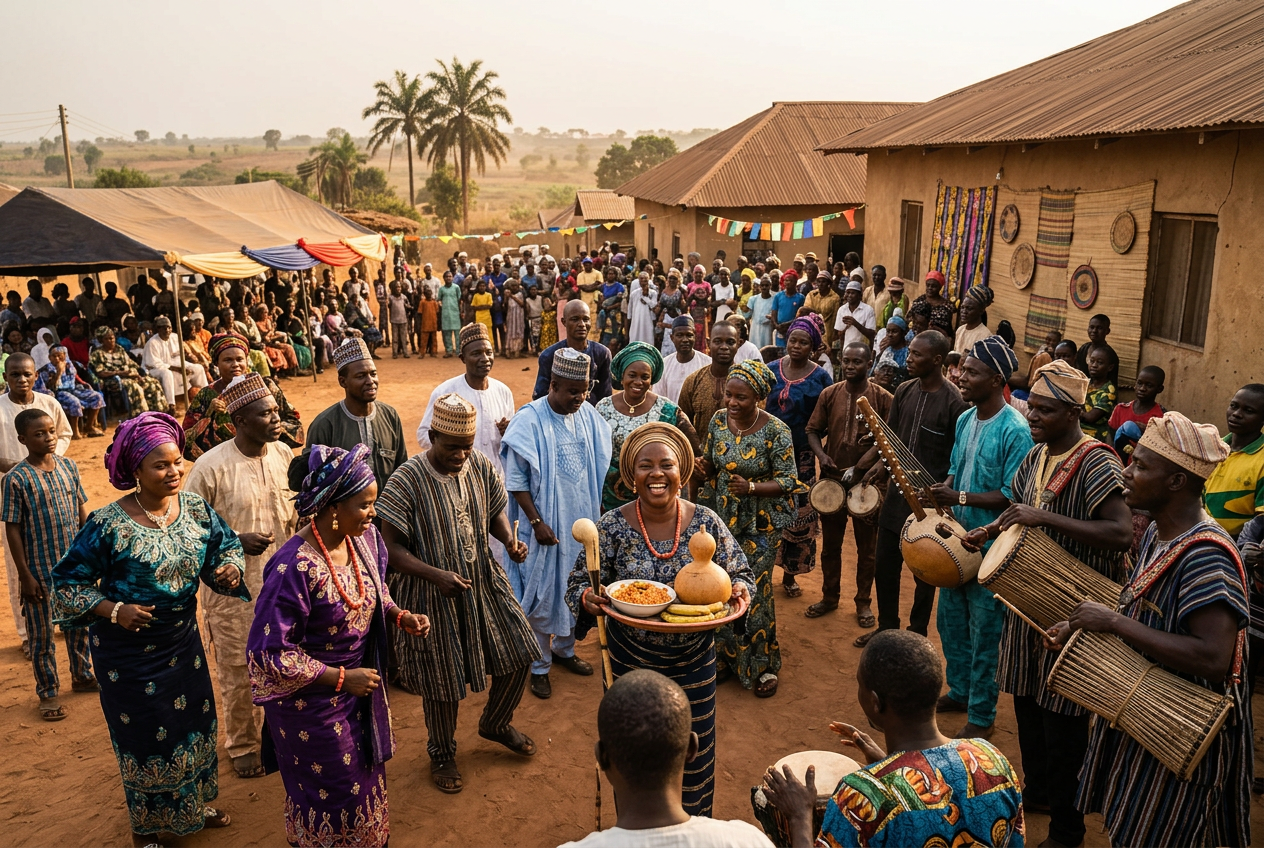
The main types of culture you will meet across Nigeria
Anthropologists usually sort culture into material and non-material, or into high, popular and folk. In Nigeria I find a more useful sorting is by how the culture is organised politically, because that is what actually shapes daily behaviour.
There are centralised hierarchical cultures, where authority runs through an emir, oba or obi with a formal court and clearly ranked titles. Sokoto, Kano, Ile-Ife, Benin City and Ijebu-Ode work this way. Protocol is elaborate, precedence is taken seriously, and the palace remains a functioning institution rather than a heritage attraction.
There are decentralised republican cultures, most famously Igbo, where the village assembly, age grades and title societies distribute authority horizontally. The saying that the Igbo have no king is an overstatement, but it captures something true about how decisions get made.
There are riverine and minority cultures of the Niger Delta and Middle Belt, often organised around clans, fishing rights and land tenure, with their own distinct festival calendars.
And there is urban Nigerian culture, which is newer, faster and increasingly the default for anyone under thirty in Lagos, Abuja or Port Harcourt. It is multilingual, code-switching, church-and-mosque adjacent, Pidgin-speaking, entrepreneurial, and only loosely attached to the village of origin that its parents still consider home.
That last category is growing fastest, and the tension it creates with the first three is the real cultural story of the decade.
Nigeria’s major cultural blocs compared
The table below sets out the four largest cultural blocs alongside the minority grouping, with approximate population shares, the political form each takes, its signature festival, and what a full set of ceremonial attire typically costs a family in Naira as of 2026.
| Cultural bloc | Main region | Approx. share of population | Political organisation | Signature festival | Full ceremonial outfit (₦) |
|---|---|---|---|---|---|
| Hausa-Fulani | North west and north east | 29 to 32 per cent | Emirate system, hereditary emirs | Durbar, Eid al-Kabir | 180,000 to 700,000 |
| Yoruba | South west | 15 to 21 per cent | Oba and chieftaincy councils | Olojo, Osun-Osogbo, Ojude Oba | 250,000 to 1,500,000 |
| Igbo | South east | 15 to 18 per cent | Village assemblies, title societies | New Yam Festival, Iri Ji | 300,000 to 1,200,000 |
| Edo, Ijaw, Efik, Ibibio | South south | 10 to 12 per cent | Kingdoms and clan councils | Igue, Ekpe, Boat Regatta | 200,000 to 900,000 |
| Middle Belt and other minorities | North central and scattered | 25 to 30 per cent combined | Mixed chiefdoms and clan systems | Nzem Berom, Tiv Kwagh-hir | 90,000 to 400,000 |
Two conclusions jump out of that table. The first is that no bloc holds a majority, which is precisely why the search for one main culture keeps failing. The second is that the minority category, taken together, is the largest entry on the list, and any account of Nigerian culture that skips it has skipped roughly a third of the country.
Population percentages here are estimates drawn from commonly cited ranges rather than a recent census, since Nigeria has not conducted a full national count that enumerates ethnicity since 1963. Treat them as orders of magnitude, not precision instruments.
What are the two cultures in Nigeria that people argue about?
Whenever this question comes up, it means one of two things, and the answer differs sharply depending on which.
The first reading is geographic and religious: the Muslim north and the Christian south. This is the division that shapes federal politics, informal power-sharing arrangements and a great deal of anxious commentary. It is real, it has genuine historical roots in the separate colonial administration of the two protectorates before 1914, and it is also lazier than it looks, because it flattens the Middle Belt entirely and ignores the millions of northern Christians and southern Muslims who inconvenience the neat map. A thoughtful Guardian analysis of how federalism attempts to reconcile common citizenship with plural identity argues that the vocabulary of unity in diversity often obscures more than it reveals, and I think that is right.
The second reading is generational: traditional culture and modern urban culture. Village and city. Aso-oke and streetwear. The elder who expects prostration and the graduate who offers a fist bump.
This second division is, in my experience, the more consequential one now.
I watched it play out at a compound in Ibadan two years ago, where a grandmother spent an entire afternoon teaching three teenagers the proper order of greeting for a family gathering, while all three quietly filmed her for a platform she had never heard of. Everyone was slightly frustrated. Everyone was also entirely sincere. That is modern Nigerian culture in a single courtyard.
The reassuring thing is that the traditional layer is not vanishing. It is being reformatted. The great festivals have arguably never been healthier, with reporting on the scale and organisation of the Olojo Festival at Ile-Ife capturing how a ceremony rooted in the Ooni’s ancient Aare crown now draws corporate sponsorship, global attendance and considerable civic pride.
Culture here does not die quietly. It gets a sponsor and a hashtag.
Final thoughts on what is the main culture in Nigeria
If you take one thing from all of this, let it be that the question contains a hidden assumption worth discarding. Countries are not required to have one main culture, and Nigeria has arranged itself deliberately otherwise, with a federal structure, a rotating national festival and a constitutional character clause all designed to prevent any single tradition from standing in for the rest.
What Nigeria has instead is three large cultures, a very substantial minority third, and a genuinely shared national layer of language, faith, food, music and family obligation that every one of those groups participates in. Ask a Nigerian in Kano and a Nigerian in Aba what culture they belong to and you will get two different answers. Ask them what makes someone Nigerian and the answers converge remarkably fast.
So the practical steps are simple. Learn the local context wherever you land, greet properly, accept hospitality, attend a festival, budget realistically for ceremonies, and resist every temptation to rank one tradition above another in public. Do that and you will find the country opens up considerably faster than any guidebook promised.
And keep asking better questions. Not which culture is main, but which culture is here, in this town, in this compound, right now.
Related Articles
If this piece has left you curious about how these cultures compare in economic terms, my earlier examination of which Nigerian communities have built the most wealth and how they did it works through the business traditions behind the headlines, including the Igba-boi apprenticeship and the northern trading networks.
And for the practical side of everything discussed above, my guide to navigating greetings, dress codes and social protocol across the country covers the daily behaviour that turns cultural knowledge into something you can actually use at a table, in an office or at a family gathering.
Key Takeaways
- Nigeria has no single main culture; the Hausa-Fulani, Yoruba and Igbo together account for roughly 60 to 68 per cent of the population, while minority groups make up around a third, so learn the local ethnic context of wherever you are rather than applying one national template.
- A real shared national culture does exist above the ethnic layer, built on Nigerian Pidgin, Afrobeats, Nollywood, jollof, football, faith, respect for elders and extended family obligation, and this is the layer to lean on when you are unsure.
- Budget and prepare for ceremonies seriously, since aso-ebi commonly costs ₦25,000 to ₦90,000 per person and a full ceremonial outfit can run from ₦90,000 to well over ₦1,000,000 depending on the tradition.
Frequently Asked Questions About What is the main culture in Nigeria
What is the main culture in Nigeria?
Nigeria has no single main culture, but the three dominant ones are Hausa-Fulani in the north, Yoruba in the south west and Igbo in the south east, together making up roughly 60 to 68 per cent of the population. Above these sits a shared national culture of Pidgin, Afrobeats, Nollywood, football, faith and extended family obligation that all Nigerians participate in.
How many ethnic groups and languages does Nigeria have?
Nigeria officially recognises 371 ethnic groups and more than 500 living languages, making it one of the most linguistically varied countries on earth. English is the official language, while Nigerian Pidgin functions as the everyday common tongue across regions.
Which is the largest ethnic group in Nigeria?
The Hausa-Fulani of the north are generally the largest single bloc, commonly estimated at 29 to 32 per cent of the population. Estimates vary widely because Nigeria has not enumerated ethnicity in a national census since 1963.
Is Nigerian culture more traditional or modern?
Both operate at once, and the interaction between them is the defining cultural feature of the country right now. Traditional festivals, chieftaincy and family rites remain strong, while urban culture in Lagos, Abuja and Port Harcourt moves at a very different speed.
What are the five elements of culture in Nigeria?
They are language, religion, social organisation, customs and traditions, and material culture covering arts, dress and food. Each element varies considerably between the 371 ethnic groups while still following recognisable national patterns.
What religion do most Nigerians practise?
Nigeria is split roughly evenly between Islam, concentrated in the north, and Christianity, concentrated in the south, according to the Federal Ministry of Foreign Affairs. Indigenous belief systems continue alongside both, often practised by the same families without any sense of conflict.
What are the two cultures in Nigeria people refer to?
The phrase usually means either the Muslim north and Christian south, or traditional village culture and modern urban culture. The second division is arguably the more significant one for Nigerians under thirty today.
What is the national language of Nigeria?
English is the official language and the medium of government, education and formal business. Nigerian Pidgin is the practical lingua franca in markets, transport and informal settings nationwide.
Which Nigerian festival is the biggest?
There is no single biggest festival, though the Durbar in the north, Osun-Osogbo and Ojude Oba in the south west, and the New Yam Festival in the south east all draw enormous crowds. The National Festival of Arts and Culture, run by the National Council for Arts and Culture, rotates between states to showcase all traditions in turn.
How much does traditional Nigerian ceremonial dress cost?
A full ceremonial outfit typically ranges from about ₦90,000 for simpler Middle Belt styles to well over ₦1,000,000 for heavily embroidered Yoruba or Igbo bridal ensembles. Aso-ebi fabric for guests at a wedding usually falls between ₦25,000 and ₦90,000 per person.
Do Nigerians identify more with their ethnic group or their nationality?
Most Nigerians hold both identities comfortably and switch between them depending on context. Ethnic identity tends to govern family, marriage and festival life, while national identity dominates in sport, music, business and life abroad.
How should a visitor approach Nigerian culture respectfully?
Establish which ethnic group predominates locally, learn a few greetings in that language, and copy how younger people address elders rather than improvising. Accept offers of food, keep religious comparisons out of conversation, and attend at least one festival before forming firm opinions.

