
 Get Guardian on Google
Hello, and welcome. Pour yourself a cup of kunu, find a comfortable seat, and let me tell you a story that begins with camels and ends with a ₦7.9 million plane ticket. People ask me who brings Islam to Nigeria almost as often as they ask me where to find decent suya in Abuja, and the honest answer is that no single person did. Islam walked in slowly, along the caravan routes that crossed the Sahara, carried by merchants, scholars, kings and, much later, reformers, over something close to eight hundred years.
This article is the conclusion of months of research and years of experience writing about Nigerian faith, history and identity. I have read the old chronicles, sat with imams who can recite their teachers’ teachers back six generations, and stood under a mud minaret in Katsina in the heat of a March afternoon wondering how anything made of earth could last that long. What I want to give you is the real chain of people, not a textbook summary.
Why does it matter who brought it? Because roughly half of all Nigerians are Muslim today, and the route the faith travelled still shapes how it is practised in Maiduguri, Kano, Ilorin and Lagos. The scale is enormous. The National Hajj Commission of Nigeria has set the Federal Government-approved fares for the 2027 pilgrimage at ₦7,560,822 for the Maiduguri and Yola zone, ₦7,672,822 for the rest of the North and ₦7,882,822 for the South. That is a national airlift, a savings scheme and a diplomatic negotiation with Saudi Arabia, every single year.
None of that existed in 1085. But the thread runs straight back there.
Who Brought Islam to Africa Before It Reached Nigeria?
To understand who carried Islam into Nigeria, you have to start somewhere else entirely, and rather earlier than most people expect.
The first Muslims to set foot in Africa were not soldiers or traders. They were refugees. Around 615 CE, while the Prophet Muhammad was still preaching in Mecca and his followers were being persecuted there, a small group of early Muslims crossed the Red Sea and sought protection from the Christian king of Aksum, in what is now Ethiopia and Eritrea. The king, remembered in Islamic tradition as the Negus, refused to hand them back to their pursuers. Africa, in other words, met Islam first as a host offering shelter. I find that detail quietly moving, and it is rarely mentioned in Nigerian classrooms.

Conquest came next, and it came from the north-east. Arab armies under Amr ibn al-As took Egypt between 639 and 642, and over the following decades they pushed west along the Mediterranean coast. Uqba ibn Nafi founded the garrison city of Kairouan, in modern Tunisia, around 670. By the early eighth century most of North Africa was under Muslim rule, and the Berber peoples of the region had begun converting in large numbers.
Here is the crucial bit for Nigeria. The Berbers, and especially merchant communities that controlled the desert crossings, became the bridge. They knew the Sahara the way a Lagos danfo driver knows the back roads around Ojuelegba: every well, every oasis, every shortcut that the maps do not show. Gold, salt, cloth, copper, horses and enslaved people moved along those routes, and so did books, prayers and ideas.
By the ninth century, Arab geographers were already writing about kingdoms south of the desert. Al-Ya’qubi mentioned Kanem, the state that would later carry Islam into Borno, as early as 872. When the Andalusian geographer al-Bakri described the capital of ancient Ghana in 1068, he recorded a separate Muslim town with its own mosques, its own scholars and its own judges, sitting alongside the king’s town. Islam in West Africa, in its earliest form, was a merchant’s faith that lived next door to royal power before it ever moved into the palace.
Then came Mali. Mansa Musa’s pilgrimage to Mecca in 1324, with so much gold that he reportedly depressed its price in Cairo, announced to the world that the Sahel had Muslim kings. More importantly for us, Mali produced the travelling traders and teachers known as the Wangara, and they will appear twice more in this story, once in Kano and once in Yorubaland.
So who brought Islam to Africa? Refugees first, armies second, and then, for the lands that matter to Nigerians, Berber and Mande merchants who treated the Sahara as a highway rather than a wall.
Who Brings Islam to Nigeria: The Direct Answer
Islam was brought to Nigeria not by one person but by a relay of carriers across roughly eight centuries: Muslim traders and scholars from North Africa first reached the Kanem court, where the scholar Muhammad bin Mani is credited with teaching Mai Hume Jilmi, who adopted Islam between about 1085 and 1097; Wangara merchants and clerics from Mali, led by Abdurrahman Zaite, then carried it into Kano during the reign of Yaji, between 1349 and 1385, and onward into Katsina and the other Hausa states; the Tlemcen scholar Muhammad al-Maghili deepened it in Kano and Katsina in the 1490s; Usman dan Fodio’s reform movement from 1804 turned it from a faith of courts and markets into the faith of the northern masses; and in the south, Malian traders, Yoruba alfas, Ilorin clerics and returning West African and Brazilian Muslims spread it through Yorubaland, while Hausa, Nupe and Yoruba traders introduced it to Igboland in the twentieth century. The closely related names you will meet again and again are:
- Muhammad bin Mani and Mai Hume Jilmi (Kanem, eleventh century)
- Mai Idris Alooma (Borno, late sixteenth century)
- Abdurrahman Zaite and the Wangarawa (Kano, fourteenth century)
- Muhammad Rumfa and Muhammad al-Maghili (Kano and Katsina, fifteenth century)
- Usman dan Fodio, Abdullahi dan Fodio, Muhammad Bello and Nana Asma’u (Sokoto, nineteenth century)
- Shehu Alimi and the clerics of Ilorin (early nineteenth century)
- Mohammed Shitta Bey and the returnee Muslims of Lagos (late nineteenth century)
Now let me walk you through how that relay actually ran.
Kanem came first because it sat at the southern end of one of the busiest desert routes, the road from the Fezzan in modern Libya down to Lake Chad. The royal chronicle of the Sayfawa kings, the girgam, records that Hume Jilmi embraced Islam under the guidance of a scholar named Muhammad bin Mani, and that his son Dunama went on pilgrimage to Mecca more than once. When later civil wars pushed the dynasty west of Lake Chad into Borno around 1380, Islam came with it. Mai Idris Alooma, who ruled Borno in the late sixteenth century, built brick mosques, made the pilgrimage and governed by Islamic law, and Borno became one of the great centres of Muslim learning in Africa. The Shehu of Borno who sits in Maiduguri today still descends from that tradition through the al-Kanemi line.
Hausaland took longer. According to the Kano Chronicle, about forty Wangara scholars from Mali arrived during Yaji’s reign, led by Abdurrahman Zaite. Yaji accepted Islam, built a mosque, and gave the newcomers official posts: Zaite became the alkali, or judge, and others became imam and muezzin. It did not stick at first. Yaji’s son Kanajeji drifted back towards the old gods when a war went badly, which tells you something important. Conversion at court was a political decision as much as a spiritual one, and it could be reversed.
Katsina followed a similar path, and it left behind something you can still touch. The Federal Ministry of Information and National Orientation, reporting on a heritage revival project flagged off in Katsina, dates the Gobarau Minaret to 1348. Other historians place the tower later, in the fifteenth century or after, so treat the exact year with a little caution. Either way, the building that grew up around it became a mosque and a school that drew teachers from as far as Timbuktu, rather like a medieval university with a mud tower for a bell.
The man who sharpened Hausa Islam was Muhammad ibn Abd al-Karim al-Maghili, a fiercely strict scholar from Tlemcen in present-day Algeria. He visited Katsina and then Kano around 1492, at the invitation of Muhammad Rumfa, the ruler the Kano Chronicle credits with twelve great innovations. Al-Maghili wrote Rumfa a treatise on the obligations of princes, a sort of manual for how a Muslim king should govern. Rumfa built the palace still known as Gidan Rumfa, extended the city walls, and, so the chronicle says, began the public celebration of Eid in Kano.
And yet, for three hundred more years, Islam in Hausaland remained mostly the religion of kings, merchants and scholars. Ordinary farmers in the villages often mixed it with older practices, and many did not practise it at all.
That changed with Usman dan Fodio.
Born in 1754 at Maratta in the Hausa state of Gobir, dan Fodio was a Fulani scholar who spent decades preaching against what he saw as corrupt, half-hearted Muslim rulers. When King Yunfa of Gobir, once his own pupil, turned on his community, dan Fodio led his followers away to Gudu in 1804 and was proclaimed Commander of the Faithful. The jihad that followed swept across the Hausa states within four years. The Sokoto State Government’s own account of the region’s religious history describes how the caliphate that emerged became a confederation of emirates owing allegiance to the Sultan of Sokoto, a title that survived British conquest and remains the most senior Muslim office in the country. His son Muhammad Bello founded Sokoto city in 1809, and his daughter Nana Asma’u, a poet and teacher, built a network of women educators that still inspires Nigerian Muslim women today.
The British, when they arrived, did something that surprised many people. Under Lugard’s system of indirect rule they kept the emirs in place and largely kept Christian missionaries out of the Muslim North, which preserved the caliphate’s institutions inside the colonial state. I have written separately about how that colonial arrangement worked in practice in my piece on whether Nigeria was a British colony. After independence, Ahmadu Bello, the Premier of the Northern Region and a descendant of dan Fodio, led conversion tours in the early 1960s that historians credit with tens of thousands of new Muslims, especially in parts of Zaria and Niger provinces.
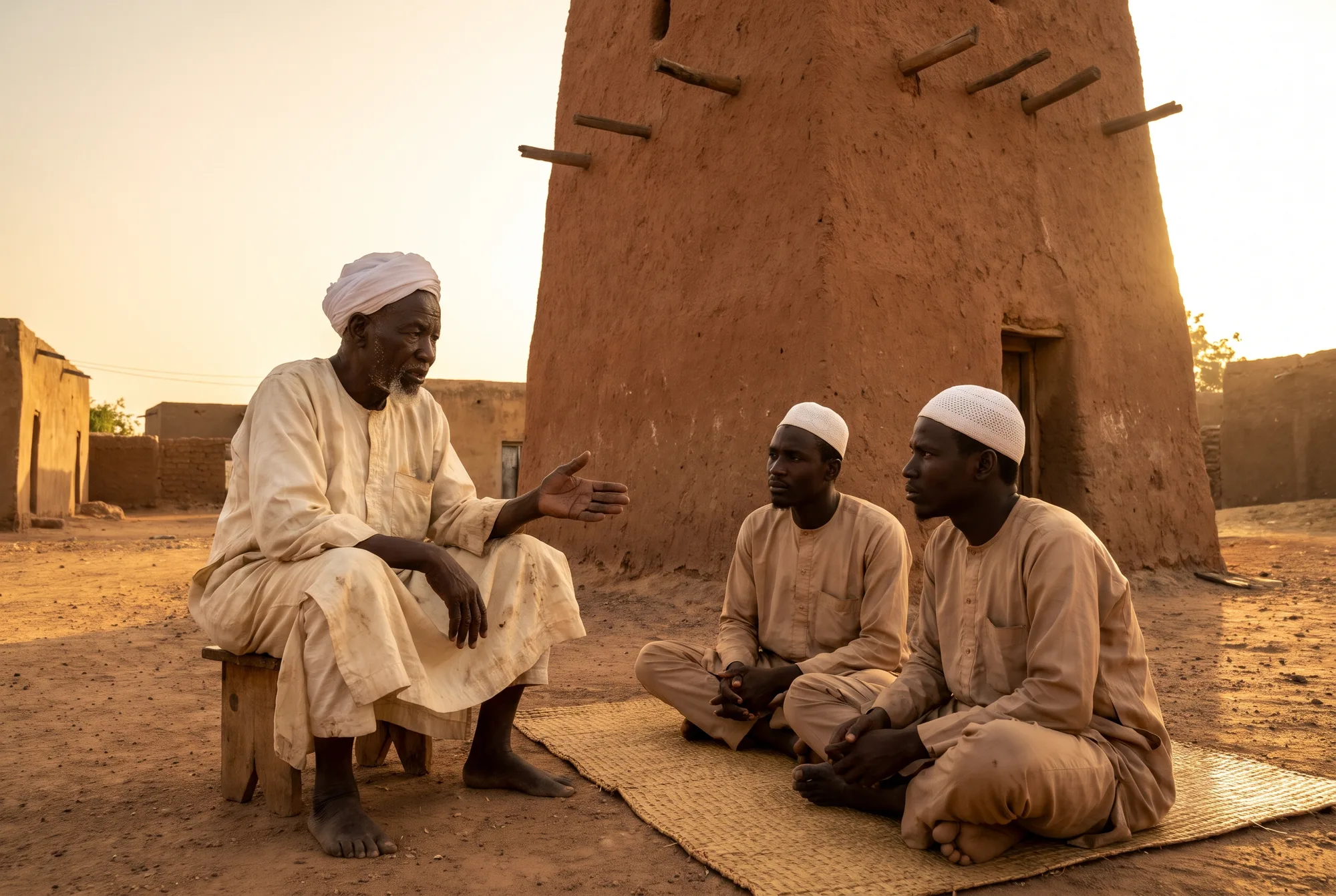
So when someone asks you who brought Islam to Nigeria, the fair reply is: traders opened the door, scholars taught the faith, kings adopted it, and reformers carried it to the villages.
Who Carried Islam Into Each Part of Nigeria: A Regional Timeline
| Region | Main carriers | Key figures | Approximate arrival | Landmark you can still visit |
|---|---|---|---|---|
| Borno (North-East) | North African and Berber traders and scholars | Muhammad bin Mani, Mai Hume Jilmi, Mai Idris Alooma | 1085 to 1097 | Shehu’s palace and central mosque, Maiduguri |
| Kano (North-West) | Wangara merchants and clerics from Mali | Abdurrahman Zaite, Yaji, Muhammad Rumfa | 1349 to 1385 | Gidan Rumfa and Kano Central Mosque |
| Katsina (North-West) | Wangara and North African scholars | Muhammad al-Maghili | 1300s to 1400s | Gobarau Minaret, about 15 metres tall |
| Sokoto (North-West) | Fulani reform movement | Usman dan Fodio, Muhammad Bello, Nana Asma’u | 1804 to 1809 | Hubbaren Shehu, the tomb of dan Fodio |
| Oyo and Iwo (South-West) | Malian (Wangara) traders and Yoruba alfas | Unnamed Malian traders | Mosque at Oyo-Ile around 1550 | Oyo and Iwo central mosques |
| Ilorin (North-Central) | Itinerant Fulani and Yoruba clerics | Shehu Alimi, Abdulsalami | 1817 to 1823 | Emir’s palace and Ilorin Central Mosque |
| Lagos (South-West) | Malian traders, then returnees from Sierra Leone and Brazil | Mohammed Shitta Bey | First mosque 1774; Shitta-Bey Mosque 1894 | Shitta-Bey Mosque, Martins Street |
| Nsukka and Abakaliki (South-East) | Hausa, Nupe and Yoruba traders | Garba Oheme, Ibrahim Nwagui | 1930s to 1958 | Ibagwa-Aka Muslim community |
The table makes one thing plain: Islam did not arrive in Nigeria once, it arrived at least eight separate times through different doors. It also shows that the southern arrivals owe almost nothing to the Sokoto jihad and almost everything to trade.
Who Brought Islam to Yoruba Land in South-West Nigeria?
This is where the popular story usually goes wrong.
Many people, including plenty of Yoruba people, assume Islam came south with the Fulani jihad, rather like a wave washing down from Sokoto. It did not. It arrived earlier and more quietly, carried by the same Malian traders who had reached Kano.
The proof is in the name. Yoruba speakers call Islam Esin Imale, and most historians trace “Imale” back to “Mali”, the religion of the Malians. Some folk explanations claim it means “the hard religion”, because of the fasting and the five daily prayers, and I have heard elders in Ibadan argue both readings with great enthusiasm over a plate of amala. But the Malian origin is the one the scholarship supports, and it preserves the trade route in a single word.
The milestones run roughly like this. A mosque was built at Oyo-Ile, the old capital of the Oyo Empire, around 1550, mainly to serve visiting Muslim traders rather than local converts. Iwo is said to have had a mosque by 1655, Iseyin around 1760, Lagos by 1774 and Saki around 1790. Islam was a quiet guest in many Yoruba towns for two or three centuries before anyone in Sokoto had heard of Usman dan Fodio.
What the jihad did change was Ilorin. A Fulani cleric known as Shehu Alimi settled there in the early nineteenth century, at the invitation of Afonja, the Oyo general who was rebelling against the Alaafin. Afonja used Alimi’s Muslim followers as soldiers, lost control of them, and was killed. Alimi’s son Abdulsalami became the first Emir of Ilorin around 1823, tying the city to the Sokoto Caliphate. To this day Ilorin is a Yoruba city with an emir rather than an oba, which surprises almost every visitor I have taken there.
Lagos had another set of carriers entirely. In the nineteenth century, Muslims returning from Sierra Leone and from Brazil, many of them descendants of enslaved Yoruba people, settled in the city and built a confident, outward-looking Muslim community. The most famous of them, Mohammed Shitta Bey, paid for the mosque on Martins Street that opened in 1894 and still bears his name. In the twentieth century, Lagos produced Ansar-Ud-Deen in 1923, the Ahmadiyya mission arrived in 1916, and in 1995 NASFAT began its Sunday prayer meetings for professionals who could not attend Friday prayers during office hours.
Yoruba Muslims have been pushing for this fuller history to be told. When the Muslim Ummah of South West Nigeria organised an international conference on the progress and challenges of the faith in the region, the aim was partly to correct the idea that Yoruba Islam is simply a northern import.
I once asked an old alfa in Iwo, a man with a white beard and the patience of a saint, whether his ancestors had become Muslim because of the jihad. He laughed for a good while. “My great-great-grandfather was praying before the Fulani even crossed the Niger,” he said. Then he poured me another cup of tea and changed the subject to football.
And the South-East? Islam arrived there last and stayed small. Hausa, Nupe and Yoruba traders and cattle dealers settled in the Nsukka area from around the 1920s, and Igbo Muslim leaders generally recognise a man named Garba Oheme as the first Igbo convert in the 1930s. In 1958 the first known group conversion took place at Enohia in the Abakaliki area, led by Ibrahim Nwagui. Igbo Muslims remain a small minority, but the community at Ibagwa-Aka has now lived through three or four generations of faith. If you want the broader picture of how the two big faiths divide the country today, my explainer on which religion is more popular in Nigeria sets out the survey figures and why they disagree.
Who Translated the Quran into Yoruba, Hausa and Igbo?
For most of Nigerian Islamic history, nobody translated the Quran at all. That is deliberate.
Muslims regard the Quran as the literal word of God in Arabic, so the Arabic text is what is recited in prayer and memorised in the Quranic schools of the North and the ile kewu of the South-West. Translations exist to explain the meaning, never to replace the original. For centuries, Nigerian scholars wrote commentaries and poems in Hausa, Fulfulde and Yoruba using Arabic script, a system known as Ajami. Nana Asma’u wrote much of her teaching poetry this way in the 1800s. If you have ever wondered how much Arabic ordinary Nigerians really know, I have written a full piece asking whether Nigerians speak Arabic that answers it honestly.
Here is the twist that delights me every time. The first published Yoruba translation of the Quran, in 1906, was produced by a Christian, the Reverend M. S. Cole, as part of missionary work in Lagos. A second Christian Yoruba translation by E. K. Akinlade followed in 1965. Muslims, for their part, began their own translations in the twentieth century.
The Ahmadiyya mission produced a Yoruba translation in parts from 1957, with the full text published in 1976. Sheikh Abubakar Gumi, the former Grand Khadi of the Northern Region, published his Hausa translation in 1979, and it became the standard text in many northern homes. The Ahmadiyya added a Hausa version in 1992 and an Igbo one, by Professor Ugoji, in the late 1980s. When the movement hosted an exhibition of its publications in Ibadan, it used the occasion to set out the dates of those translations.
The Igbo story has a second chapter. On 1 July 2022, Sheikh Muhammed Muritala Chukwuemeka, a former Deeper Life Bible Church pastor who converted to Islam in 1989, launched his own Igbo translation at the Ansar-Ud-Deen Mosque in Abuja after about five years of work. It drew some criticism over linguistic errors, which he promised to correct, and he argued that his plain, general Igbo would reach more readers than the earlier version written in the Enugu dialect.
Practical tip, if you are shopping for one: in the Islamic bookshops around Lagos Central Mosque or along Kano’s Kofar Mata area, a bilingual Arabic and Hausa or Arabic and Yoruba Quran typically sells for somewhere between ₦8,000 and ₦30,000 depending on binding and size. A pocket edition is fine for reading on the go, but if you want to study the meaning properly, choose a large-print edition with the translation on the facing page rather than underneath, because it makes cross-checking far easier on the eyes.
Who Is the Head of Islam in Nigeria Today?
Short answer: the Sultan of Sokoto.
Longer answer: Islam has no pope, so “head” means something more like “most senior recognised leader”. Alhaji Muhammad Sa’ad Abubakar III has held the title since 2 November 2006 as the twentieth Sultan, and he descends directly from Usman dan Fodio. He serves as President-General of the Nigerian Supreme Council for Islamic Affairs, the umbrella body founded in 1973, and as President-General of Jama’atu Nasril Islam, the northern organisation Ahmadu Bello helped establish in 1962. One of the most visible parts of his job is announcing the sighting of the new moon that starts and ends Ramadan, which is why millions of Nigerians wait for his statement before they break fast or dress up for Eid.
The structure beneath him is cleverly balanced. The Shehu of Borno, Abubakar Ibn Umar Garbai El-Kanemi, is the permanent Deputy President-General for the North. A Yoruba leader, Alhaji Rasaki Oladejo, serves as Deputy President-General for the South, and Professor Is-haq Oloyede, the former JAMB registrar, has long served as Secretary-General.
Pause on that for a second. The two most senior Muslim leaders in Nigeria today are the heirs of the Sokoto Caliphate and of the Kanem-Borno tradition, the two great carriers of the faith in this article. The history is not behind them. It is sitting at the top table.
Respect for the Sultan runs wide, and Muslim groups across the regions tend to rally around him whenever his office is challenged. The rights group MURIC, in a birthday tribute to the Sultan’s leadership, described him as a detribalised figure, which is exactly the quality his job demands in a country this diverse.
That said, not every Nigerian Muslim looks to Sokoto. The Shia Islamic Movement in Nigeria follows Sheikh Ibrahim El-Zakzaky. Sufi brotherhoods such as the Qadiriyya and Tijaniyya have their own spiritual leaders, and the Izala reform movement has its own national structure. Some Yoruba Muslims, while respecting the Sultan, insist that their own faith developed independently and has its own leadership traditions. The Emir of Kano is generally regarded as the second most influential traditional Muslim ruler in the country.
So the Sultan is the head in the way a respected elder is the head of a large and occasionally quarrelsome family. Everyone stands when he enters. Not everyone takes his advice.
Following the Trail: Visiting Nigeria’s Islamic Heritage Sites
Reading about all this is one thing. Standing in front of it is another.
Northern Nigeria’s Islamic architecture has a look you will not find anywhere else. Traditional Hausa builders worked in tubali, cone-shaped sun-dried mud bricks, reinforced with palm wood, and finished their walls with smooth earth plaster in warm ochres and reds. Roof parapets often rise into horn-like points called zanko, and the grandest gateways carry raised geometric patterns moulded straight into the clay. It is architecture designed for heat: thick walls, small openings, deep shade, and courtyards that stay cool in the afternoon. Even if you never set foot in a mosque, an hour walking the old city of Kano will teach you more about this history than a week of reading.
A word on styling before you go, because getting it right is a form of respect. For men, a plain cotton kaftan or a flowing babban riga with trousers and a simple cap is ideal, and you will find decent ready-made kaftans at Kano’s Kurmi Market for roughly ₦15,000 to ₦40,000. For women, an ankle-length dress or skirt with long sleeves and a headscarf works everywhere, and a light chiffon scarf costs from about ₦2,000. Choose pale, breathable fabrics; dark polyester in Kano’s dry season is a punishment you do not deserve. Slip-on sandals save time, because you will be taking your shoes off at every prayer hall.
Here is how I would plan a first trip.
- Check the current security advice for every state on your route before you book, because travel conditions in parts of the North-West and North-East change quickly, and plan to fly between cities rather than drive long rural stretches.
- Start in Lagos with the Shitta-Bey Mosque on Martins Street and Lagos Central Mosque nearby, ideally on a weekday morning when it is quieter and the caretakers have time to talk.
- Fly or drive to Ilorin, about 300 kilometres north of Lagos, and visit the Emir’s palace and central mosque to see where Yoruba Islam and the Sokoto Caliphate met.
- Fly from Lagos or Abuja to Kano, budgeting roughly ₦150,000 to ₦250,000 for a one-way domestic ticket depending on how early you book, then spend a full day in the old city around Gidan Rumfa, the Central Mosque and the dye pits at Kofar Mata.
- Hire a licensed local guide in Kano for about ₦15,000 to ₦30,000 a day, because a good guide will open doors, explain the Kano Chronicle sites and tell you when photography is welcome.
- Make the roughly 170-kilometre trip from Kano to Katsina only if current advice allows, to see the Gobarau Minaret, which stands about 15 metres tall and is still the city’s proudest landmark.
- Time any visit to a working mosque around the five daily prayers, never walk in front of someone who is praying, ask before taking photographs of people, and avoid Friday midday unless you have been invited to attend.
Sokoto, with the tomb of Usman dan Fodio at Hubbaren Shehu, and Maiduguri, with the Shehu’s palace, are both extraordinary, but check conditions carefully and go only with trusted local contacts. History will wait for you. Your safety comes first.
Final Thoughts on Who Brings Islam to Nigeria
So, who brings Islam to Nigeria? A Kanem scholar teaching a king. Forty Malian clerics walking into Kano. A strict Algerian theologian writing letters of advice to a Hausa sultan. A Fulani reformer who refused to be silenced. Malian traders whose homeland survives in the Yoruba word for the faith. Returnees from Freetown and Bahia building mosques in Lagos. Hausa cattle traders settling quietly near Nsukka. It is a relay, not a single runner, and every region of the country received the baton from a different hand.
What strikes me most, after all these months of reading and travelling, is how much of the story was peaceful, commercial and personal. The great exception, the Sokoto jihad, is the part everyone remembers, yet in the South-West and South-East the faith spread through friendships, marriages and market stalls. Knowing that does not settle any modern argument. It does make those arguments better informed.
If this has sparked your curiosity, here is where I would go next:
- Ask the oldest Muslim in your family or street which town their forebears’ faith came through, and write down the answer before it is lost.
- Borrow or buy a copy of the Kano Chronicle in translation and read the entries for Yaji and Muhammad Rumfa yourself; they are short and surprisingly lively.
- Visit one heritage mosque near you this year, dressed respectfully and outside prayer times, and spend twenty minutes simply looking at how it was built.
Related Articles
If the earliest part of this story caught your attention, it fits inside a much older timeline, and I have traced the whole sequence, from Nok terracotta to the first Badagry mission, in my guide to which religion was first in Nigeria, which picks up the question of what Kanem believed before Hume Jilmi’s conversion. And for readers who want to see how Nigeria’s Muslim story fits the continent’s bigger picture, my piece on Africa’s largest religion weighs Islam against Christianity across all fifty-four countries and explains where Nigeria sits in that balance.
Key Takeaways
- Islam reached Nigeria in stages: Kanem around 1085 to 1097, Kano between 1349 and 1385, a deepening in the 1490s under al-Maghili, and a mass spread after Usman dan Fodio’s jihad of 1804.
- Yorubaland received Islam from Malian traders long before the jihad, which is why the Yoruba call it Esin Imale, while Igboland only gained an indigenous Muslim community from the 1930s onwards.
- The Sultan of Sokoto, a descendant of dan Fodio, leads Nigerian Muslims through the NSCIA, with the Shehu of Borno, heir to the Kanem tradition, as his northern deputy.
Frequently Asked Questions About Who Brings Islam to Nigeria
Who brings Islam to Nigeria?
Islam was brought to Nigeria by a long chain of carriers rather than one person, beginning with North African traders and the scholar Muhammad bin Mani at the Kanem court in the late eleventh century. Malian Wangara clerics, the scholar al-Maghili and later Usman dan Fodio’s reform movement then spread it across Hausaland and beyond.
Who brought Muslims to Nigeria first?
The first Muslims in what is now Nigeria were traders and scholars from North Africa who reached the Kanem kingdom around Lake Chad. Mai Hume Jilmi, who adopted Islam between about 1085 and 1097, is remembered as the first Muslim ruler in the region.
Who brought Islam to Yoruba land?
Islam reached Yorubaland mainly through Malian traders and clerics, known as Wangara, from roughly the fourteenth century onwards. A mosque was standing at Oyo-Ile by around 1550, centuries before the Sokoto jihad influenced Ilorin.
Who brought Islam to Africa?
The first Muslims in Africa were refugees from Mecca who sheltered with the Christian king of Aksum around 615 CE. Arab armies then took Egypt and North Africa in the seventh century, and Berber and Mande merchants carried the faith across the Sahara.
Who translated the Quran to Yoruba?
The first published Yoruba translation came from a Christian missionary in Lagos, the Reverend Cole, in 1906. Muslim translations followed, including the Ahmadiyya version issued in parts from 1957 and published in full in 1976.
Who is the head of Islam in Nigeria?
The Sultan of Sokoto, Alhaji Muhammad Sa’ad Abubakar III, is regarded as the spiritual leader of Nigerian Muslims. He is President-General of the Nigerian Supreme Council for Islamic Affairs and has held the sultanate since November 2006.
When did Islam come to Nigeria?
Islam first reached Nigerian territory in the late eleventh century through the Kanem-Borno kingdom in the North-East. It arrived in Kano in the fourteenth century, in Yorubaland by the fourteenth to sixteenth centuries and in Igboland only in the twentieth century.
Was Islam brought to Nigeria by force?
For most of its history in Nigeria, Islam spread peacefully through trade, scholarship, marriage and royal conversion. The main exception was Usman dan Fodio’s jihad from 1804, which overthrew the Hausa kings and established the Sokoto Caliphate.
Why do the Yoruba call Islam Esin Imale?
Most historians trace the word Imale to Mali, because Malian traders were the first to bring the faith to Yoruba towns. The name therefore means roughly the religion of the Malians, although some popular explanations link it to the strictness of Islamic practice.
How did Islam reach Igboland?
Islam reached Igboland through Hausa, Nupe and Yoruba Muslim traders who settled around Nsukka from the 1920s. The first recognised Igbo convert embraced Islam in the 1930s, and the first group conversion took place at Enohia in 1958.
Which is the oldest mosque in Nigeria?
No surviving building has an uncontested claim, because the earliest mosques in Kanem and Kano were rebuilt many times over the centuries. Katsina’s Gobarau Minaret, which the federal government dates to 1348, is often cited as the oldest standing Islamic structure in the country.
How much is the Hajj fare from Nigeria in 2027?
The approved 2027 Hajj fare is ₦7,560,822 for the Maiduguri and Yola zone, ₦7,672,822 for other northern states and ₦7,882,822 for the South. The National Hajj Commission set 2 December 2026 as the deadline for states to remit all fares.