

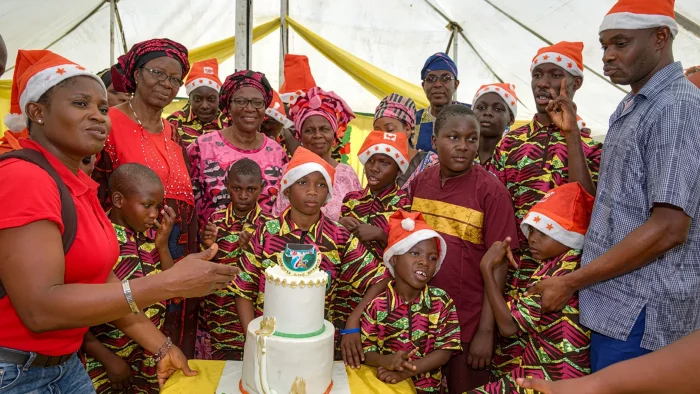
“Children with disabilities do not need pity, they need pathways. They need opportunity,” this was the submission of the founder, Equal Education Chances (EEC) Mary Olanrewaju (née Bakry).
That conviction is the driving force behind a fast-growing disability-focused charity transforming inclusive education and vocational empowerment across the United Kingdom and Nigeria.
According to the UK-based educationist, counsellor, life coach, and community trainer, EEC is closing long-standing gaps in access, dignity, and opportunity for children and young people with disabilities who are too often left behind by traditional systems.
She added that in many parts of the world, children with disabilities still struggle for visibility, dignity, and access to education.”
EEC’s vision was shaped by the realities Mary witnessed growing up in Nigeria, where children with disabilities were frequently excluded, ignored, or exploited. One childhood memory became a turning point: a young girl with a disability denied vocational training and confined to household chores.
“That moment stayed with me,” Mary recalls. “I knew children like her deserved more -education, skills, and a voice.” That promise became the foundation of EEC.
Since its inception, Equal Education Chances has reached 1,273 children, delivering inclusive learning, school feeding programmes, vocational training, hygiene education, and psychosocial support. For many beneficiaries, it marked their first experience of structured education in an environment where they felt seen and valued.
In the United Kingdom, EEC supports children with disabilities through youth mental health programmes, inclusive learning initiatives, and community empowerment projects. A flagship initiative, the Faith and Neurodiversity (FAN) Project, equips churches, youth groups, and faith leaders with practical tools to understand, support, and include neurodiverse children and adults-
In Nigeria, EEC’s work is deeply rooted in underserved communities. The foundation operates across eight schools in Lagos and Kano States, including special schools and inclusive units where children with disabilities face severe barriers such as poverty, stigma, limited resources, and exclusion from mainstream education.
EEC has delivered interventions in: Igbehin-Adun Special School (Okokomaiko), Community Primary School Special Inclusive Unit (Ajangbadi), All Saints Primary School Inclusive Unit (Agege), New Oko-Oba Primary School Inclusive Unit, Oki Primary School Inclusive Unit (Ipaja-Alimosho), Ore-Ofe Primary School Inclusive Unit (Dopemu), Amosun Primary School Inclusive Unit (Agege), and Dan Shayi Special School in Kano State.
Beyond food and learning materials, EEC restores confidence, skills, and hope vocational empowerment is a core pillar of EEC’s work. Young people are trained in tailoring, hairdressing, barbing, ICT and digital skills, catering, bead-making, crafts, and creative arts, -pathways to independence, self-worth, and economic participation.
EEC’s latest initiative, The Bridge, is an inclusive education resource designed to empower 50,000 teachers across Nigeria. Recently launched in the UK in the presence of the Mayor and Lord Mayor of Manchester, the book is positioned as both a practical tool and a movement for systemic change. Plans are underway for a major Nigeria launch with government support.
A call beyond charity driven by faith, family, and strong partnerships, EEC continues to advocate for systemic reform. Its call to policymakers is clear: invest in inclusive education, fund early intervention, train teachers effectively, and partner with grassroots organisations delivering real impact.
Across borders and barriers, Equal Education Chances is proving that when inclusion is intentional and opportunity is provided, children with disabilities do not merely survive, they rise.
