

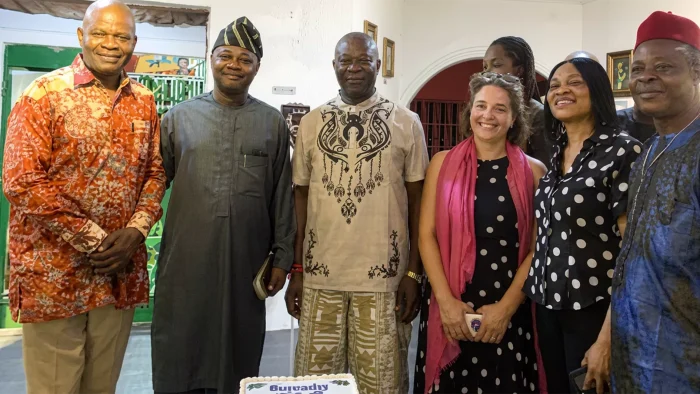
Preserving national history is a necessity. A nation that documents its past is better equipped to understand its present and shape its future. Hence, in its mandate to protect Nigeria’s story, the Center for Research, Information and Media Development (CRIMMD) opened its new facility recently marking a pivotal turn in protecting collective memory for generations to come.
CRIMMD, founded and led by Dr Raphael James, moved from its former base in Idimu to a larger 13-room building designed to better house Nigeria’s stories. The new space is structured as multiple museums in one, with each room dedicated to a different aspect of Nigerian life and history.
According to Dr. James, the goal is to document Nigerian history as it happens, using objects people can relate to. Unlike conventional museums that focus mainly on rare or elite artefacts, CRIMMD preserves everyday items – currency notes, postage stamps, old magazines and newspapers, bottles, photographs, and tools once used in Nigerian homes.
“This is a history museum not restricted to a particular type of artefact. Everything that can tell the Nigerian story belongs here. In doing so, the museum captures how ordinary Nigerians lived, worked, and expressed themselves over decades and centuries.”
Programme Manager at United Nations Habitat in Nigeria and chairman of the occasion, Prof. Johnson Bade Falade described the opening as more than a ceremonial moment. “This event is not just about unveiling a building. It is about affirming memory, identity, and our shared creativity as a people.” He also acknowledged the support of the German Embassy in Nigeria, noting that cultural partnerships can bridge nations and strengthen understanding across borders.
Prof. Falade praised Dr. Raphael’s long-standing commitment to Nigerian arts and history, noting that his work shows how culture can be both educational and transformative. He also pointed out the significance of the museum’s location on the mainland, describing it as a deliberate move to bring history closer to everyday people. “Heritage does not belong to elites alone. It belongs to the community.”
Also speaking at the event, Director of the Goethe-Institut Nigeria, Dr Nadine Siegert, commended CRIMMD for what she described as a “transition museum.” She explained that preserving everyday objects is one of the most effective ways to keep history alive. Sharing a personal reflection, she recalled creating a small museum in her childhood home. “Seeing CRIMMD do this on such a large and meaningful scale is truly special,” she said.
She reaffirmed the Goethe-Institut’s support and thanked the Ford Foundation for funding the relocation of the museum.
The opening ceremony was attended by cultural leaders, academics, activists, and creatives from across the country, reinforcing CRIMMD’s growing national relevance. Among them were Founding Curator of Natural History Museum, Obafemi Awolowo University, Ile-Ife – Prof. Adisa Ogunfolakan; Nigerian Activist, Joe Okei-Odumakin; Chancellor of African American University, Prof Ben Ezeohagwu; Cultural Archivist, Jahman Anikulapo, alongside professionals from publishing, tourism, and academia.
