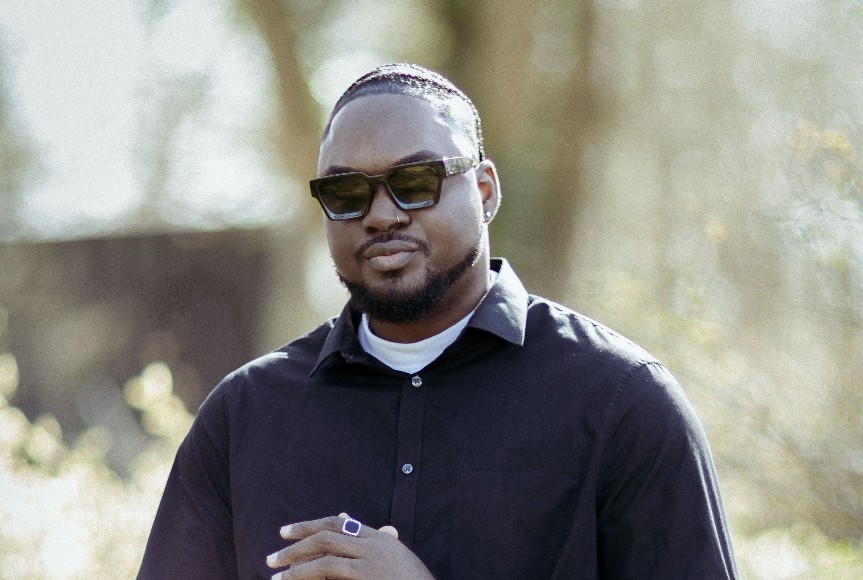
“CAN I see a brighter smile?” he says, angling his shot towards the couple. He takes a further step towards them, beaming his lenses with precision. “Now, throw the bouquet in the air, and hold each other.” The air was soaked in euphoria and giddy chatter from the couple and their friends, as Michael Ataansuyi focused on getting the larger-than-life, intimate, storytelling-laden shots that have coloured his portfolio for over a decade.
“It always starts with storytelling,” he tells The Guardian. “Before I start any shoot, I tend to absorb the story first and decide on the unique perspectives to approach it with.” From corporate events, to industry profiles, to lifestyle (birthdays, weddings, and parties) shoots, Michael Ataansuyi has carved out his niche as a photographer, cinematographer, drone pilot and filmmaker over the years. His portfolio travels through Lagos, to other parts of sub-Saharan Africa, and the United Kingdom, where he’s captured sensitive moments for diverse audiences, including government officials, entertainment celebrities, and general individuals alike.
Prior to his recent UK-based catalogue, Ataansuyi has also built an impressive portfolio as a Nollywood filmmaker. His stint includes social issues shorts like his 2017 debut, “Huzuni”, which also screened at the continent’s biggest film festival, Africa International Film Festival (AFRIFF). It also bagged an award in the best child actor category at the Abuja International Film Festival, in the same year. His other short films, including “Gift” and “Close” have also featured across notable festivals such as the African Smartphone International Film Festival and the Realtime International Film Festivals, opening Ataansuyi up to global opportunities in his ongoing crusade to tackle social issues with films. He also directed the mental health advocacy documentary for the She Saves Nigeria organisation, all before 2020.
In recent years, he founded Topshooter Studios in the UK, expanding his cinematic gaze towards other core parts of human life, especially lifestyle — birthdays, weddings, anniversaries, parties, concerts — and portraits for brand advertisements. From the sitting governor of Lagos state, Babajide Sanwo-olu, to award-winning hitmaker Juls, Ataansuyi’s portfolio is a versatile panorama of candid storytelling, crisp cinematics, and cathartic still/motion images.
In this chat with The Guardian, the Nigerian creator shares his experience, navigating a busy life of lights, cameras and clapperboards; sharing his proven methods behind achieving world-class photo/video shoots; overcoming challenges on the job; and lore behind his most celebrated shots, among others.
What drew you into the world of cinematography and photography?
Definitely my passion for storytelling, and making sure our existence—our activities and time spent here on Earth—are properly spent and recorded in the sands of time.
You seem to have built niches around nighttime, street work, and weddings. What drew you to these particular formats and styles?
So, for the nightlife, when I came into it, I’d say it was one aspect that was slightly overlooked. I mean, people just did it anyhow. There was no structured storytelling to how things were being recorded or documented. So I felt the need to fix that. And so far, I think we’ve been doing an amazing job.
And what drew me to weddings, aside from anything else, is the fact that love is a beautiful thing. To love and be loved is a very beautiful thing. We Nigerians have a way with weddings: colourful, glamorous, and whatnot. Imagine doing all that and then finding out it wasn’t properly documented, your story wasn’t told, and you can’t look at your pictures and smile with the memories they bring back.
Yeah, yeah, to be honest that’s it. The money side wasn’t there when we all started. Back in university, there was really no money in it. It was more about the passion, the storytelling, and making sure things were properly documented. Because it’s very important—if you don’t document things right, you lose it and forget. And people after you forget too.
I remember growing up and seeing my parents’ wedding album. It brings me great joy that they invested that much in making sure things were properly documented. It was the first thing we gave visitors whenever they came around. It brought back good memories for them and the visitors—some of them even attended the wedding. For those who didn’t, it gave them that sense of, “Oh, your wedding looked so nice!” and they’d ask what happened in different moments. And then my parents would explain: “This was when we were about to cut the cake,” “This was my twin sister when she did this.” It made a lot of sense that it was well documented.
So, every wedding, a different couple. Every couple is unique, so I approach every wedding I work on as a fresh story, a fresh start. I lean into what they are comfortable with. These days, everybody wants to pose as a supermodel. However, wedding pictures are meant to be those raw, exciting moments properly documented. It’s a moment that doesn’t look staged, but it also looks really good. I mean, the story is intact.
The theme of the shoot also matters a lot. For instance, if you are shooting a CEO or a corporate fellow. Everything about that shoot needs to show power, to announce the person in charge. So, you need to know the poses in your head. They have to come in that format.
What’s one signature that connects across every style of photography you explore?
One thing that cuts across all my work has to be that rawness. When you look at my pictures, you would feel that authenticity. I always play around with angles, and I focus on preserving the rawness of the moment. Presently, I’m editing a 70th birthday event. I was very shocked that they loved the pictures I took instantly from seeing the previews. I thought to myself, “This was definitely a moment they will never forget. So, regardless of what I’m doing, for instance if it’s a night club, l’m probably focused on capturing something crazy. Basically, I am freezing that moment for them that they would always cherish. They’d remember that exact moment. So that nostalgia is one feeling I always like to evoke while working on any client’s project; I want them to remember the particular moment. Of course, quality is also very important. I will never compromise on the technical details to achieve the right look and feel.
Back to weddings. What is your favourite part of the shoot?
You know that moment when the groom is waiting for the bride to join him, and then she walks in and he sees her. Not just the groom, everyone sees her. That’s a very crucial moment, how they look at her. They’re always overwhelmed with their emotions. So, it’s mostly capturing tears of joy; or people trying to capture the moment with their phones or cheering them on. Of course, I also like the parts after dressing up, where they give you time to document their wedding look. There’s less rush during this part. But my favourite part is still that moment where they say, “Can we rise as the bride makes her way into the hall?” That moment is always very important. Another core moment is when they exchange their vows and the couple’s first kiss.
What has been your craziest moment on set so far?
To be honest, I’ve had a lot of crazy moments. For instance, I’ve had a couple of busy days where I have about four or five bookings in one day. But one for the books will be my shoot with the incumbent Lagos State governor during his election period was hectic. I shot his official Television Campaign. We had a window of 30 minutes with the governor. And we were supposed to shoot other accompanying clips in Marina, drive a bit around Lagos, Mile 2, and Computer Village. It took a lot of intense, urgent planning, but we pulled that off. The Governor was very calm with us. He even gave us more than 30 minutes. the time. It was a very mind-blowing and humbling moment for me. Everyone listens to the governor and he tells them what to do, but for the whole of that shoot the governor was listening to me and I was telling him what to do, in terms of poses. When I asked him to re-do something, he would redo it.
Another moment would be my shoot with MoniePoint Headquarters in London, and documenting Tosin Eniolorunda and Felix Ike. It was a fantastic experience. There was a day we were to do an interview with him, and everything went wrong, from my microphone messing up, to Tosin not getting the script until he got on set, to not having a teleprompter to guide him. The shoot did not come out as expected, because we had to re-shoot for free.
Where do you operate from most of the time?
Right now, I’m in London full-time. But I travel a lot for work. For example, a bride I’ve known for years booked me for her December wedding in Manchester. She has booked us since April. I’ll be in Manchester about three or four times in December. Once in Sheffield too. So my work falls under a few categories: lifestyle, corporate, and then commercials. One thing we started in London nightlife was creating proper TV commercials for club events. It never existed before we did it. For example, Teeny Money’s birthday—we created an ad where invitations were delivered in pizza boxes. No scenes from the club. That was the whole promo. It set a standard. For Nigerian Independence Day, we printed a newspaper-style invitation and filmed a girl dropping it at different doors.
Finally, what would you say you want to build as your legacy in this world of media and cinematography?
You know, I didn’t even realise that I had been doing this for a while, until I was talking to someone, and I realised that she graduated from secondary school the same year I was graduating from university. And I have been doing this since then. As for my legacy, I want to redefine common stereotypes in the cinematography/photography scene; how event pictures are taken, how videos are recorded, lifestyle, and corporate branding. There are still big things to work on next year. It’s about breaking stereotypes, changing the way things are naturally done, and doing it better.