

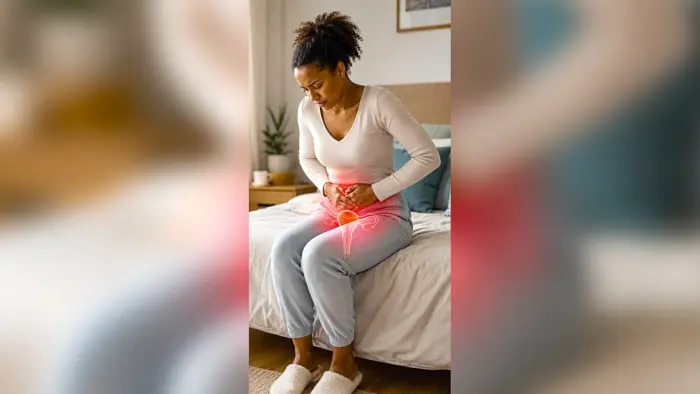
There is a proscribed disposition around the issues of menstruation in this part of the world, such that even women consider being quiet about the excruciating pains, complications, burden and trauma attached to this monthly bleeding way of life in order to avoid being offensive.
Thus, a regular African woman hides the issues and complications around her period. If for unforeseen reasons her period’s cat is let out of the bag in any form in the public: stains, pains or mood swings, she apologises for being a woman and hides herself in shame.
This is why even when she experiences period complications as bad as excess bleeding that threatens her existence, heavy clotting, excruciating painful cramps/dysmenorrhea, anemia and bleeding between periods, she feels compelled to deal with the trauma in silence because her society would not hear of it, her boss would not hear of it, her job will suffer and she would be tagged unproductive.
“Unfortunately, the same society would shame a woman who is of conception age but unable to do so based on complications that might have erupted from menstrual inadequacies,” Dr. Amarachi Chuka, a fertility expert stated when asked why the issues around menstruation are kept inside the closet.
Explaining the difference between a normal menstruation and abnormal, Dr Chuka said: “A normal monthly menstruation or period is a moderate bleeding that lasts three to seven days within a 21-35 days cycle and accompanied by mild physical and maybe emotional symptoms as the case may be. These symptoms include lower belly or back ache caused by contracting uterus, mood swings, bloating, mild acne, tender breast etc.
“While abnormal or irregular period is when it is accompanied with severe pains that stops you from doing normal daily task; the bleeding soaks through the sanitary package every hour for several hours; period last longer than seven days and cycle is shorter than 21 days or longer than 35 days, or when you miss your period for three to four months in a row without being pregnant.”

She continued: “With abnormal periods there is most likely an underlying health issue that can affect a woman’s reproductive health and fertility. This is because menstruation and womanhood are intertwined. A woman’s ability to conceive and become a mother is mostly dependent on how healthy her menstrual cycle leading to ovulation is.
“Irregular cycles make it hard to track ovulation hereby lowering the conception chances. It can also cause gestational diabetes or high blood pressure during pregnancy.
“Also, abnormal bleeding more often than not points to reproductive health issues such as endometriosis, polycystic ovary syndrome (PCOS) and uterine fibroids.”
The fertility expert however noted that for some women, their period comes easy and there is nothing to tell, but for a whole lot of other women, their monthly period comes with complications that demand intentional gynecologist care.
The question however is why should women continue to bear the brunt of severe menstrual pains and complications in silence just because the society perceives everything surrounding a woman’s monthly period a normal female genetic peculiarity that should not be openly discussed? What is normal about pain – any kind? What is normal about a situation that could lead to reproductive health issues and fertility complications? What is normal about bleeding out one’s ability to live healthy?
According to the World Health Organisation (WHO), more than two in three women and girls experience menstrual pain. In a 2026 systematic review cited by WHO estimated that 71 per cent of women and girls experience dysmenorrhoea, with the condition capable of affecting daily activities and quality of life.
WHO notes that severe menstrual pain can be a reason to seek healthcare, particularly when it interferes with everyday life. Menstrual pain can also occur alongside conditions such as endometriosis, uterine fibroids, while conditions including PCOS can cause irregular periods and other menstrual problems.
Polycystic Ovary Syndrome
POLYCYSTIC Ovary Syndrome (PCOS) is a hormonal disorder that causes irregular periods, high androgen level which is the male hormone and small cysts on the ovaries. The symptoms of PCOS include the following:
. Irregular Periods – related to heavy bleeding, inconsistent period and missed period.
. Skin Issues – causing severe acne and sometimes excessive oil skin.
. Excess Hair Growth – on the face, chest and back.
. Fertility struggles due to irregular ovulation.
Endometriosis
ENDOMETRIOSIS is a long-term medical condition where tissue similar to the lining of the uterus grows outside of the uterus. It is accompanied with severe pelvic pain which is associated with menstrual cycle and worsens over time. Symptoms are: Painful periods also known as dysmenorrhea, heavy or abnormal bleeding, infertility, pain during bowel movement or urination, fatigue and digestive issues.
Uterine Fibroids
UTERINE Fibroids are non-cancerous growth made of muscle and connective tissues that develop in or on the wall of the uterus. The symptoms include heavy menstrual bleeding, pelvic pressure, back pain, pain during sex and frequent urination. However, research revealed that some women with uterine fibroids have no symptoms at all.
The fertility experts said all of the above reproductive health issues are closely-knit with abnormal bleeding and menstruation in women.
Different Menstrual Strokes For Diverse Women
OLAMIDE Ojo, who is above 40, said her menstrual pain is particularly severe on the first day. According to her, the pain is so sharp and intense that she cannot stand or function until she receives an injection. Even then, the relief is only partial.
She also bleeds for seven days. “Is this something that can be considered normal, or could there be an underlying issue causing such severe pain? I genuinely want to understand,” Ojo asked.
While menstrual cramps are common, the severity can vary considerably. Some women experience discomfort that passes within hours, while others describe pain accompanied by vomiting, back or leg pain, heavy bleeding and an inability to carry out normal activities.
Mrs Ngozi, menstrual difficulties developed later in life. She said her periods were relatively smooth when she was younger but became increasingly difficult after pregnancy and childbirth.
Her periods became unstable and irregular, eventually leading to a diagnosis of polycystic ovary syndrome, PCOS.
She said the changes have left her frustrated and increasingly uncomfortable with the thought of menstruation.
Her experience shows that menstrual health can change at different stages of a woman’s life, while changes in menstrual patterns and pain may sometimes be linked to underlying medical conditions.
Chidinma Ogu, menstrual pain has not led to hospitalisation, but it has affected her ability to carry out everyday responsibilities.
She described the sensation as though something was constantly twisting or pulling inside her stomach. “It’s a very intense cramping in my lower abdomen which sometimes spreads to my lower back,” she said.
Ogu said she began to realise that her experience might be different after having open conversations about menstruation with other women and noticing that she appeared to experience more severe pain and mood changes than some of them.
The pain, she said, sometimes affects her productivity, particularly when she is required to stand for long periods. “Things that would take less effort will seem difficult. I’ll just want to lay down in bed and wait for the pains to reduce,” she said.
She manages the pain by lying down in a comfortable position and using a warm compress when it becomes unbearable. She said she has never used pain-relief medication or sought medical attention for the pain but perhaps she should.
The experience also affects her emotionally. “When I am in much pain, I can become irritable, frustrated and emotionally drained. It can be difficult to remain positive at that time,” she said.
Ogu said the severity of her symptoms is sometimes misunderstood by people around her. “Most times when people see when I am going through this severe menstrual pain, they would have that expression that says: it’s just your period, what is the big deal, without understanding that I am genuinely struggling internally, physically, emotionally and mentally.”
While menstrual pain is common, persistent or debilitating pain should not automatically be dismissed as something every woman must endure.
However, the experience has affected different aspects of their lives, from productivity and emotional wellbeing to their ability to attend school or carry out normal responsibilities.
Yet, despite the severity or changes in their symptoms, some women continue to receive dismissive responses when they complain about menstrual pain.
The 23-year-old Mirabel Ajero revealed that the struggle began at age 12. She said the onset of her period was accompanied by severe stomach pain and vomiting, sometimes becoming so intense that she had to spend up to two days in the hospital.
“Growing up as a child, I hated my period, but I knew I needed to see it to make me a woman,” she said.
Years later, Ajero said she still dreads her menstrual cycle because of the severity of the symptoms. “It’s not just menstrual pain for some of us – there’s a mental feeling of danger to our body and also our health, one that is inevitable”, she said.
Beyond the physical symptoms, Ajero said the reluctance to openly discuss severe menstrual experiences makes it difficult for some women to receive understanding and support.
She recalled telling friends and other women that she hated seeing her period, only to be met with disapproving reactions. “I’m not surprised because in the African setting, you must go through pain or have a threshold for pain to make you qualify as a real African woman,” she said.
Sharing her menstrual journey experience on severe pain that accompanied it, Adebimpe Aremu said: “I started menstruating when I was 13, but the painful cramps started when I was 16.”
Her first experience came at midnight. Her period had not even started, but she was already vomiting and experiencing severe pain. Her mother, who did not know what was happening, rushed her to the hospital.
“Immediately after I was admitted, I was put on a drip, and the doctor had to conduct a pregnancy test. The doctor was our family doctor, and he told my mum to ask me if I was sure I wasn’t pregnant. My mum, with so much confidence, said she was sure, especially since I had not even started menstruation.
“The pregnancy test came back negative of course. We hadn’t left the hospital before my period started. That was when we realised the pain was caused by menstrual cramps.”
Since then, Aremu said she has always dealt with painful periods, although they have not been as extreme as that first experience.
Another particularly bad experience came in 2016, when she was already in the university. She was vomiting and purging when her neighbour saw her and gave her Felvin, which brought relief. “My neighbour told me she also experiences painful periods and uses Felvin, which works for her.”
Aremu said she once went to see a gynaecologist, and was told it was normal and that it was simply how her body reacted. “I can’t really remember the details because I was very young at the time, but I was given some medications that worked.”
However, she noticed that the effect she experienced after taking Felvin was similar to what she experienced with the medications prescribed by the doctor. “My period would not flow as quickly as it normally should, and that bothers me. But I still take Felvin because, honestly, I would choose it over experiencing those cramps any day, any time.”
Tumininu Adeniyi’s experience was different. She had never paid much attention to menstrual cramps until she began experiencing them herself.
What started as something she had never really worried about gradually became a painful part of her menstrual cycle. She said the cramps were far more intense than what she had seen her friends experience, and they were accompanied by vomiting and pain in her legs.”
