 Follow Us on Google News
 Follow Us on Google Discover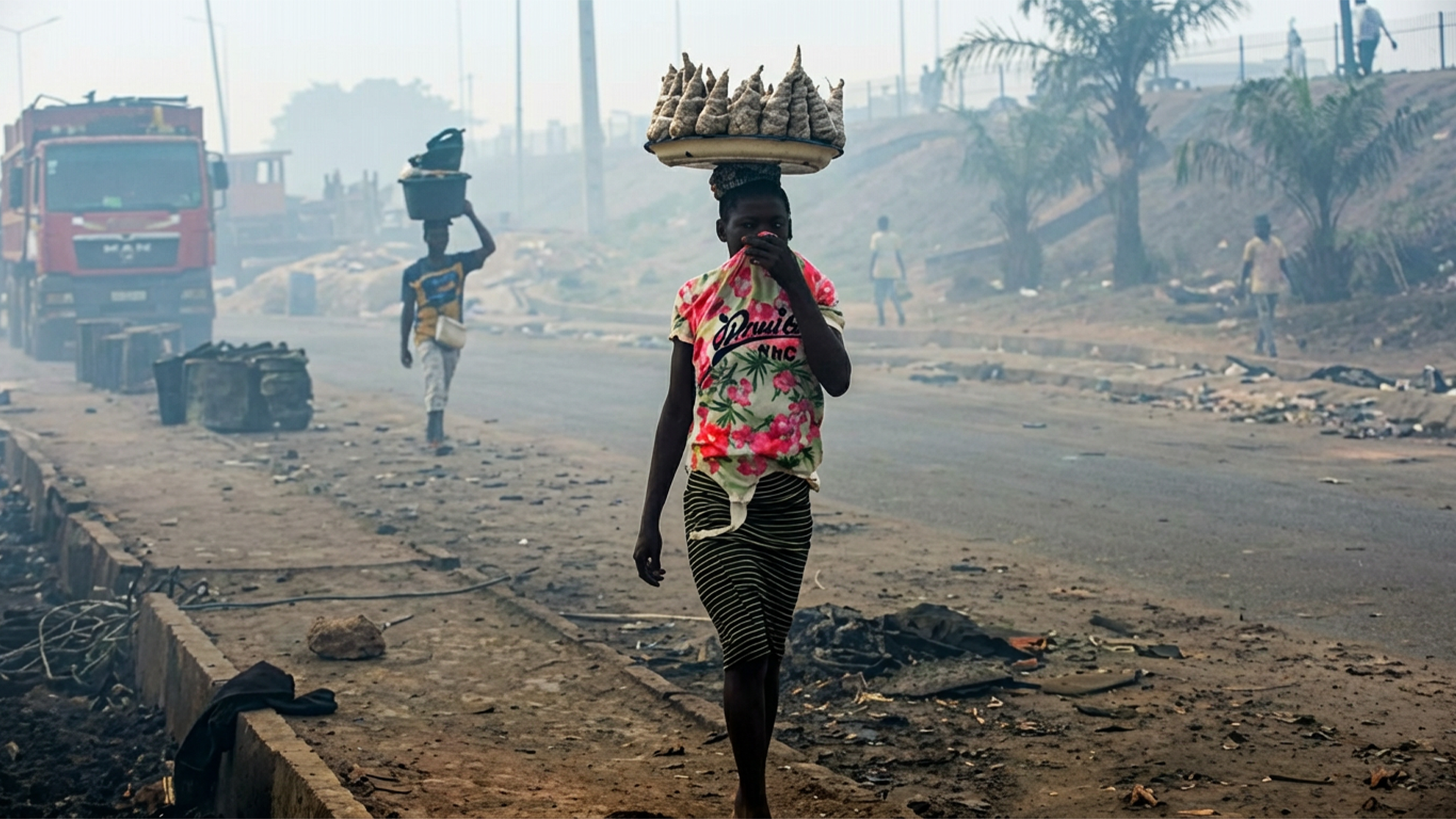
By Bertram Nwannekanma
For millions of Lagos residents, pollution is something they encounter every day without necessarily seeing it.
It is in the exhaust fumes that hang over a busy road during rush hour. It is in the smoke from a generator powering a shop, office or home. It rises from refuse being burnt in a neighbourhood. It comes from construction sites, industrial facilities and poorly maintained vehicles. And unlike a dirty canal or overflowing dumpsite, there is often nowhere to point to and say: this is the pollution.
Yet Lagos residents breathe it all the same.
That is what makes air pollution different from many other environmental threats confronting the state. Nobody can choose not to breathe. A resident may avoid a polluted canal, refuse to live beside a dumpsite or decide not to drink contaminated water. But wherever he lives, works or travels, he must breathe the air around him.
For Lagos, one of Africa’s most densely populated and economically active cities, that makes air quality more than an environmental statistic. It is increasingly a public-health concern.
The World Health Organisation identifies air pollution as a major health risk, with fine particulate matter capable of penetrating deep into the lungs and, in the case of the smallest particles, entering the bloodstream. Prolonged exposure has been associated with cardiovascular and respiratory diseases, stroke and lung cancer.
The challenge is that some of the most dangerous pollutants are invisible.
A heap of refuse can be seen. Noise can be heard. Dirty water may be recognised by its appearance or smell. But microscopic particles suspended in the air can enter the human body without warning.
This is why monitoring matters.
The Lagos State Environmental Protection Agency (LASEPA) has increasingly incorporated air-quality monitoring into its environmental regulatory responsibilities, providing Air Quality Index information to indicate conditions in different parts of the state.
In 2025, LASEPA, working with partners including the University of Lagos, the Lagos Metropolitan Area Transport Authority (LAMATA) and AirQo, brought stakeholders together to validate a Pan-Sectoral Air Quality Management Action Plan for Lagos State. The emphasis on a pan-sectoral approach is important because Lagos cannot clean up its air through environmental regulation alone.
A city that runs on combustion
The sources of pollution are woven into the everyday life of the megacity. Transport contributes to emissions. So do generators, industrial operations, construction, waste burning and other combustion activities.
In August 2025, LASEPA’s General Manager, Dr Babatunde Ajayi, said vehicular emissions accounted for an estimated 70 per cent of the choking smog affecting Lagos. He also disclosed that more than 12,000 vehicles had been checked under the state’s emissions-control efforts during the year.
The figures raise a larger question: what kind of city does Lagos want to become as its population, traffic and economic activities continue to expand?
It is difficult to separate the quality of the air from the quality of the city’s transportation system.
A poorly maintained vehicle that belches smoke into a traffic queue is not merely a nuisance to the driver behind it. The fumes are inhaled by pedestrians, roadside traders, traffic officials, transport workers and other motorists.
The same is true of thousands of generators running simultaneously because homes and businesses need alternative sources of electricity. Every unnecessary hour spent idling in traffic has an environmental cost. Every vehicle emitting excessive smoke adds to the burden. Every open-air fire releases pollutants into an atmosphere shared by everyone in the neighbourhood.
This is why the fight for cleaner air cannot be reduced to enforcement exercises. It must also involve better public transport, improved traffic management, cleaner energy, stronger emissions standards and more efficient urban planning.
The power of data
Perhaps the most important change in Lagos’ approach is the growing recognition that pollution must be measured before it can be effectively controlled.
For years, environmental policy in many developing cities has been constrained by inadequate data. Authorities may know that pollution exists, but without reliable measurements, it becomes difficult to determine its concentration, sources, trends and impact. Air-quality monitoring stations and sensors therefore serve a purpose far beyond producing an index on a website. They can help identify pollution hotspots, establish patterns and provide evidence for regulatory decisions.
Instead of merely asking whether there is smoke in a particular location, authorities can begin asking more precise questions: What pollutant is present? Where is it concentrated? At what time does it peak? What is its likely source? Which communities are most exposed? And what intervention would produce the greatest improvement?
Those questions are essential in a city as complex as Lagos.They are also important because exposure is not evenly distributed. The trader who spends 10 hours beside a congested road does not experience the same environment as someone who drives past the same road in an air-conditioned vehicle.
A traffic officer standing beside a busy junction, a bus driver navigating Lagos’ notorious congestion and a child playing near a heavily trafficked road may all experience different levels of exposure.
Air pollution is therefore also an issue of inequality. Those with the fewest options to escape polluted environments may be the ones carrying the greatest burden.
From enforcement to consciousness
LASEPA’s regulatory role remains critical. Facilities that violate emissions standards must be held accountable, just as vehicle owners whose cars release excessive smoke should understand that the problem goes beyond the condition of their engines.
But enforcement alone cannot produce lasting behavioural change. Clean air must become a shared responsibility.
Lagos residents should eventually become as familiar with the Air Quality Index as they are with weather forecasts. Schools should understand when outdoor activities could expose children unnecessarily. Industries should regard emissions compliance as a normal cost of doing business, not an inconvenience imposed by regulators.
Transport operators must recognise that vehicle maintenance is also an environmental responsibility.
Government, meanwhile, must continue investing in reliable monitoring while making air-quality information easier for ordinary residents to understand and use.

The wider policy choices matter too
Cleaner buses, stricter emissions testing, improved traffic flow, controls on industrial pollution, discouragement of open burning and a gradual transition towards cleaner energy should not be treated simply as climate-change aspirations. They are public-health interventions.
The ultimate measure of success, therefore, should not only be the number of vehicles tested, facilities sanctioned or monitoring stations installed. It should be whether the air that enters the lungs of millions of Lagosians is becoming cleaner.
There is a tendency to measure environmental progress by what the eye can see: cleaner streets, better drainage, greener spaces and improved landscapes. But perhaps one of Lagos’ most important environmental achievements will be something nobody can see.
Cleaner air leaves no monument. It builds no bridge. It cuts no ribbon. But every Lagosian breathes its benefits.
Nwannekanma is a Lagos based journalist.

