

By Ene Oshaba, Abuja
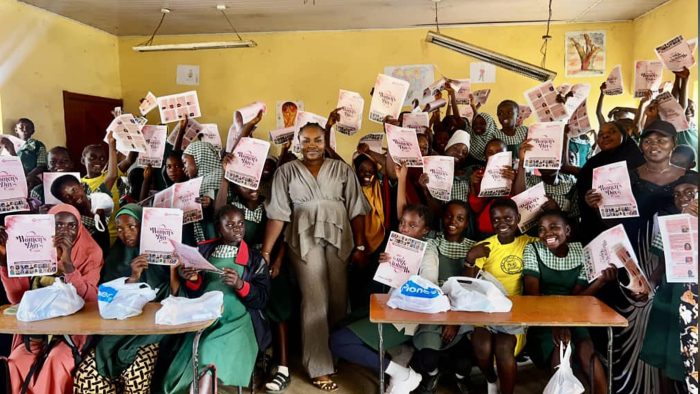
In the quiet, densely populated community of Paipe, tucked within the Idu Industrial Area of Abuja, a different kind of lesson unfolded at LEA Primary School, one not found in textbooks, yet deeply essential to the future of the girl child.
In commemoration of this year’s International Women’s Month, Impact Network, a youth- and women-focused social enterprise, brought its advocacy to the school with a clear message: success is not one-size-fits-all, and young girls can aspire to become more than just what they see around them.
At the heart of the outreach was a unique initiative, profiling 20 Nigerian women who are not necessarily in the spotlight but are making meaningful impact in their various fields. The goal, according to the organisation’s founder, Rose Ojochide Akor, was simple yet powerful: expand the imagination of young girls.
“We wanted them to know that their choices are not limited to what they see on television or in their immediate environment. You can be anything, an engineer, a caterer, a business owner and still be successful,” Akor said.
Beyond inspiration, the outreach tackled a subject often cloaked in silence, menstruation.
For many of the girls present, it was their first time engaging in an open conversation about menstrual health. What began as hesitation gradually turned into participation, as more girls found the courage to speak.

Thirteen-year-old Angel Unde, the head girl of the school, shared her experience with a mix of innocence and honesty. Like many girls her age, she initially struggled with fear and uncertainty. “I learned how to keep myself clean and not be ashamed,” she said quietly.
Angel admitted she once felt the need to hide her menstruation, worried about being laughed at especially in a community where, as she described, “there are too many boys.”
Her fears, though not based on direct experience, reflect a wider reality: the stigma surrounding menstruation remains deeply ingrained.
Another participant, Ibrahim Kadijat, a secondary school student and alumna of the school, echoed the importance of the session.
“I learned that we should not be ashamed. It is something normal,” she said, adding that the outreach helped reinforce confidence among the girls.
While the outreach focused on empowering girls, it also exposed deeper societal challenges within the Paipe community.
Teachers and school administrators pointed to a troubling pattern of early pregnancies among girls and increasing concerns about the behaviour of boys in the area.
One teacher recounted that several girls who had passed through the school were unable to continue their education due to unintended pregnancies.
“Some of them didn’t even understand what was happening until it was too late,” she said.
She stressed that while educating girls is critical, the absence of similar engagement for boys leaves a dangerous gap.
“If you talk to the girls and leave the boys, the problem will remain,” she noted, calling for targeted interventions for male children.
The outreach also sparked a broader discussion on the need for comprehensive gender education.
School authorities acknowledged that while informal guidance exists, structured teaching around gender sensitivity and mutual respect is largely absent from the curriculum.
“We need to teach boys to understand and respect girls, especially on issues like menstruation,” an assistant head teacher said, advocating for the inclusion of gender studies in primary education.
Such a move, she explained, would not only address stigma but also equip children with the knowledge to navigate social realities responsibly.
For Impact Network, the outreach was more than a one-day event, it was part of a broader philosophy anchored on giving back.
The organisation runs year-round initiatives, including scholarships, school supply support, food drives, and periodic mentoring sessions across different communities. “This is not something we do once a year,” Akor explained.
“If we want a better society, we have to build the people around us,” she stressed.
The choice of Paipe was deliberate. Having previously visited the community, the team identified an urgent need for intervention, particularly among young girls growing up in challenging social environments.
While the outreach made a tangible impact, it also raised important questions about sustainability and scale.
Akor called on government institutions to rethink their approach to social interventions, urging support for grassroots initiatives and innovative ideas.
“We need to move beyond the usual structures and support people who have practical solutions to real problems,” she said.
At the same time, educators and community members emphasized the need for a more inclusive approach, one that brings boys into the conversation, strengthens parental involvement, and bridges the gap between school and home.
As the session ended, what lingered was not just the distribution of sanitary pads or pamphlets, but a subtle shift in mindset.
For girls like Angel, the conversation may have started with hesitation, but it ended with understanding, and perhaps, a sense of empowerment.
In a community where challenges remain stark, initiatives like this serve as a reminder that change often begins with small, deliberate steps: a conversation, a lesson, a new way of seeing oneself.
And in Paipe, in this International Women’s Month, a group of young girls began to see possibilities far beyond their immediate world.
